- The Price of Repair
- The New Allies
- Venser, the Artificer of Urborg
- Radha, the Warrior of Keld
- The Campaign of Sacrifices
- Karn: The Journey into the Past
- Teferi: Leading by Sacrifice
- Freyalise: The Guardian of Skyshroud
- Lord Windgrace: The Protector of Urborg
- The Duel of Dragons
- The Loss of Zhalfir
- Jeska's Final Sacrifice
- The Mending: The End of the Gods
- The Weakening of the Oldwalkers
- A New Generation
- The Reckoning: What Was Won and Lost
- What Was Lost
- What Was Won
- The Shadows of the Future
- Sources and References
The sky above Dominaria was bleeding. Where stars had once shone, gaping fissures tore through reality itself — luminous wounds that pulsed with impossible energy, draining the world's mana like cosmic leeches. Several centuries had passed since the Apocalypse, since the victory over Yawgmoth, and yet Dominaria had not healed. On the contrary, the plane was dying.
Welcome to episode 7 of our exploration of Magic: The Gathering lore. We've reached the climax of the Era of Rifts: the Time Spiral. In the previous episode, we discovered the eight rifts tearing through Dominaria and how Teferi came to realize the magnitude of the disaster he had helped create. Today, we follow the desperate quest to close these cosmic wounds — a quest that will demand the most terrible sacrifices the Multiverse has ever known.
The Price of Repair
Teferi and Jhoira had spent months studying the rifts, analyzing their structure, searching for a way to close them. Their research led them to a terrifying conclusion: each major rift could only be sealed by the sacrifice of a planeswalker's spark.
The spark — that quasi-divine essence that allowed planeswalkers to traverse the Blind Eternities and travel between planes — was the only energy powerful enough to cauterize these cosmic wounds. The last Oldwalkers had to be convinced to renounce their immortality, their near-divine power, to save a world they had known for millennia.
The process itself was unimaginably violent. The spark had to be torn from the planeswalker's soul — not given freely as a gift, but ripped out, forcibly channeled into the rift. The planeswalker felt every fiber of their immortal being tearing apart, millennia of accumulated power evaporating in an instant. Those who survived the procedure found themselves diminished, mortal, vulnerable — echoes of what they had once been.
The task seemed impossible. The Oldwalkers were proud beings, accustomed to their unlimited power. Why would they sacrifice everything they were for a plane that represented but a single drop in the infinite ocean of the Multiverse?
On the left, Delay represents the suspension of time, with spells held suspended between seconds before manifesting. In the center, the Rift Elemental shows the creatures born of temporal anomalies, feeding on the energy of phased objects. On the right, Rift Bolt illustrates the chaotic energies that escaped from these cosmic wounds.
The New Allies
Venser, the Artificer of Urborg
In the putrid swamps of Urborg — where the remains of Phyrexia still festered — Teferi and Jhoira discovered an extraordinary young man. Venser lived alone in a dilapidated workshop, salvaging Phyrexian components to build his inventions. His father, a scavenger, had disappeared into the swamps years before, leaving him orphaned.
Venser harbored a deep hatred for Urborg and dreamed of escaping this nightmare of mud and death. To achieve this, he had built the Ambulator — a teleportation device powered by two identical Power Stones he had discovered in the ruins. But his experiments had met with little success.
What Venser didn't know was that he possessed a natural gift: he could teleport instinctively, without conventional magic. Teferi immediately recognized what this meant — a latent planeswalker spark, ready to awaken.
Teferi's arrival triggered a chain reaction. During a disturbance caused by the rift above Urborg, Venser was sucked into a temporal anomaly with his new companions. With the magical aid of Teferi and Jhoira, he succeeded in his first planeswalk — his spark finally awakening.
For Venser, it was a revelation. All his life, he had believed his abilities came from his machines, from his genius as an artificer. But his power had been within him from the very beginning — a flame ready to ignite. The Ambulator was merely a catalyst, a tool for channeling what he already possessed. This realization transformed the shy, solitary young man into a determined ally of Teferi's cause.
Radha, the Warrior of Keld
Another crucial ally joined their cause: Radha, a warrior of mixed blood. The granddaughter of Keldon warlord Astor, she possessed the ashen skin and imposing muscles of her Keldon heritage, but also the pointed ears and blue markings of the Skyshroud elves.
Teferi identified Radha as "the first discovery of a new race of potential planeswalkers." She shared a strange connection with the rift above Skyshroud — a resonance suggesting a dormant spark potential. This connection made her invaluable for channeling the mana needed to close the rifts... but also terribly vulnerable.
On the left, Jhoira, Ageless Innovator — one of the first students of the Tolarian Academy, made immortal by water infused with temporal anomalies. In the center, Jhoira's Familiar, a flying automaton she built to assist her through the centuries. On the right, Jhoira's Timebug, an artifact she used to manipulate temporal flows.
The Campaign of Sacrifices
Equipped with new knowledge and new allies, Teferi and his companions began their campaign to close the rifts. One by one, the last great planeswalkers of the old era were confronted with an impossible choice.
Karn: The Journey into the Past
The first rift to be closed was the one over Tolaria — the island where Urza had conducted his catastrophic temporal experiments, where Barrin had cast a spell of obliteration that had amplified the damage beyond all repair.
Karn, the silver golem turned planeswalker, was the only one capable of accomplishing this task. He used his powers to travel through time itself, returning to the era of the Invasion — before Barrin destroyed Tolaria. There, he gave his spark to seal the rift at its source.
The sacrifice worked, but the cost was terrible. Deprived of his spark, Karn became vulnerable to something he had carried within him since his creation: the glistening oil of Phyrexia, inherited from Xantcha's heartstone. Without the spark to contain it, the corruption began to take control of his mind.
Karn fled to Mirrodin, his artificial plane, leaving behind a sinister message: "Do not follow me." But as he fled, he left traces of glistening oil on every plane he crossed — sowing the seeds of a future Phyrexian catastrophe.
This sacrifice set a crucial precedent. Karn proved that the rifts could indeed be closed — but also that the price was appalling. For the other Oldwalkers, the message was clear: the end of their divine existence might be the only way to save the Multiverse.
Karn's corruption by the glistening oil also revealed a troubling truth: even the most powerful planeswalkers carried within them the seeds of their own destruction. The silver golem had been created by Urza using Xantcha's heartstone — a converted Phyrexian — and that infected origin was now catching up with him. The acts of the past, even the most heroic ones, had unforeseen consequences. This lesson, the planeswalkers of the new era would learn the hard way.
Teferi: Leading by Sacrifice
After Karn's departure, it was Teferi who set the example. The rift above Shiv was one of the two he himself had created by phasing the continent of dragons out of reality. He could not ask others to pay for his own mistakes.
At Shiv, Teferi gave his spark.
The process was devastating. In an instant, the power that had defined him for millennia vanished. The ability to travel between planes, immortality, mastery of time itself — all were gone. Teferi became mortal. A simple human, as vulnerable as anyone else.
Jhoira, who had known him for centuries as the most powerful chronomancer in the Multiverse, watched him collapse after the ritual. Wrinkles appeared on his face. Fatigue — a sensation he had long forgotten — fell upon him. For the first time in his long existence, Teferi felt the weight of the years he had accumulated. He was still a powerful mage, but his intimate connection with time had been broken. He could no longer suspend seconds, bend minutes, rewind hours. He was a prisoner of time, like all mortals.
But his sacrifice bore fruit. The Shiv rift closed, and the continent of dragons could finally return to reality, reclaiming its place on Dominaria after centuries of absence.
On the left, Teferi's Protection, a powerful spell representing his ability to isolate things from reality — the same magic that had phased Zhalfir and Shiv. In the center, Reality Strobe shows the chaotic effects of temporal manipulations on the fabric of reality. On the right, Vanishing evokes the gradual disappearance of everything that had made Teferi a god among mortals.
Freyalise: The Guardian of Skyshroud
Freyalise was the elf planeswalker who had ended the Ice Age by casting the World Spell. Since then, she had fiercely protected the Skyshroud forest — which she had transported from Rath to Dominaria during the Phyrexian Invasion.
But Freyalise had become xenophobic with age, refusing to listen to Teferi's warnings about the rifts. She preferred to protect her forest in her own way, even using slivoids as a military army. Her resistance was broken by an unexpected invasion.
Phyrexians from an alternate reality — a world where the Ice Age had never ended — emerged from the Skyshroud rift. The Weaver King, a malevolent psychic entity, usurped her control over the slivoids. Exhausted, cornered, Freyalise finally had a moment of clarity: she at last understood Teferi's sacrifice.
In one final heroic act, Freyalise recalled all the protective magic she had maintained over Skyshroud since the Rathi Overlay. She channeled a massive explosion of green and red mana into the rift, sealing it forever. The price was terrible: Freyalise died, and the entire Skyshroud forest perished with her. Only one tree survived — the last vestige of all that she had protected.
Lord Windgrace: The Protector of Urborg
Lord Windgrace was a humanoid panther of incomparable nobility — a planeswalker even older than Urza. He remembered Urborg as a verdant forest, before the explosion of the Sylex submerged the region and transformed it into a cursed swamp. This catastrophe had instilled in him a deep hatred for everything related to artifice.
The "panther king of Urborg" had been one of the Nine Titans during the Invasion. When Urza had descended into madness and killed Taysir, it was Windgrace who had recovered the fallen planeswalker's heart to place it alongside his own — a symbolic act of his nobility.
The rift above Urborg was one of the most dangerous, threatening to release Phyrexians from an alternate reality and to reawaken the corruptions still buried in the soil. Windgrace did not hesitate. With a dignity that commanded respect, he gave his life to the rift.
But before disappearing, Windgrace cast one last spell: he merged his spirit with Urborg itself, becoming an eternal guardian of the land he had protected for so long.
On the left, Lord Windgrace in all his majesty, the panther king of Urborg. In the center, Urborg, Tomb of Yawgmoth — the swamp where the remains of Phyrexia continued to corrupt the land. On the right, Windgrace's Judgment, representing the destructive power he could unleash against the enemies of his domain.
The Duel of Dragons
Not all Oldwalkers were prepared to sacrifice themselves. Nicol Bolas, the oldest and most powerful of the dragon planeswalkers, categorically refused to contribute to closing the rifts.
The dragon saw in this crisis an opportunity. The planeswalker Leshrac, the Walker of Night, was using the Mask of Night's Reach to control Jeska and forcibly close rifts. Leshrac hoped to defeat Bolas and steal his power to become the most powerful being in the Multiverse.
He formally challenged him to a duel on Madara — where the oldest rift of all gaped open, created fifteen thousand years earlier during a battle between Bolas and a demonic leviathan.
The fight was epic. Leshrac even managed to paralyze Bolas between the Talon Gates and to temporarily neutralize his planeswalking powers. For a moment, victory seemed possible.
But Bolas had a hidden trump card: he had already defeated the Myojin of Night's Reach and possessed her original mask — superior to Leshrac's. The dragon impaled his opponent with the skeletal remains of his tail, then used the mask to capture his essence.
And that is how Bolas closed the Madara rift — not with his own spark, but with Leshrac's life force. He eliminated a rival while solving the problem, sacrificing nothing of himself.
"Why would I save a world I can dominate?" — Nicol Bolas
The Loss of Zhalfir
The Zhalfir rift was forcibly closed by Jeska, under Leshrac's mental influence. She used Radha as a conduit to channel the necessary mana. The process worked — the rift sealed shut.
But unlike Shiv, which had been able to reclaim its place in reality, Zhalfir could not return. Teferi's homeland — the land where he was born, where all those he had sought to protect lived — remained phased out of existence.
And Teferi, now mortal, no longer had the power to bring it back. The Destroyer of Zhalfir now bore that title with absolute bitterness.
For Radha, the price was equally terrible. Channeling so much mana through the rifts had permanently extinguished her potential spark. She could never ascend as a planeswalker. But the experience had transformed her — her impulsive and cruel temperament had softened, becoming more rational and caring.
On the left, Jeska, Thrice Reborn — the one who had been Phage, then Karona, then a planeswalker (as we saw in the previous episode). In the center, Radha, Heir to Keld, the half-elf warrior whose potential spark was sacrificed to close the rifts. On the right, Jeska's Will, showing the raw power she could channel.
Jeska's Final Sacrifice
One last rift remained: the one over Otaria. The most diffuse, the hardest to close — for it had been created by the destruction of Karona, and Karona had been the very embodiment of mana.
Jeska had lived several lives. She had been a warrior, a monster, a goddess, and now a planeswalker. She had caused immense destruction as Phage and Karona. Perhaps it was time to repair. Perhaps it was time to find redemption.
In an act of absolute bravery, Jeska did not merely give her spark to the Otaria rift. She poured all of her planeswalker essence onto the rift — and beyond, onto every rift and fissure in the Multiverse.
Her spark. Her memory. Her soul. Everything she was, everything she had been, poured into the cosmic wounds.
And something extraordinary happened.
Jeska's sacrifice triggered a chain reaction throughout the entire Multiverse. The remaining rifts closed all at once. The mana stopped leaking. Dominaria breathed again.
In her final moments, Jeska had a vision: she saw her brother Kamahl again, long dead, who welcomed her. Then she accepted oblivion.
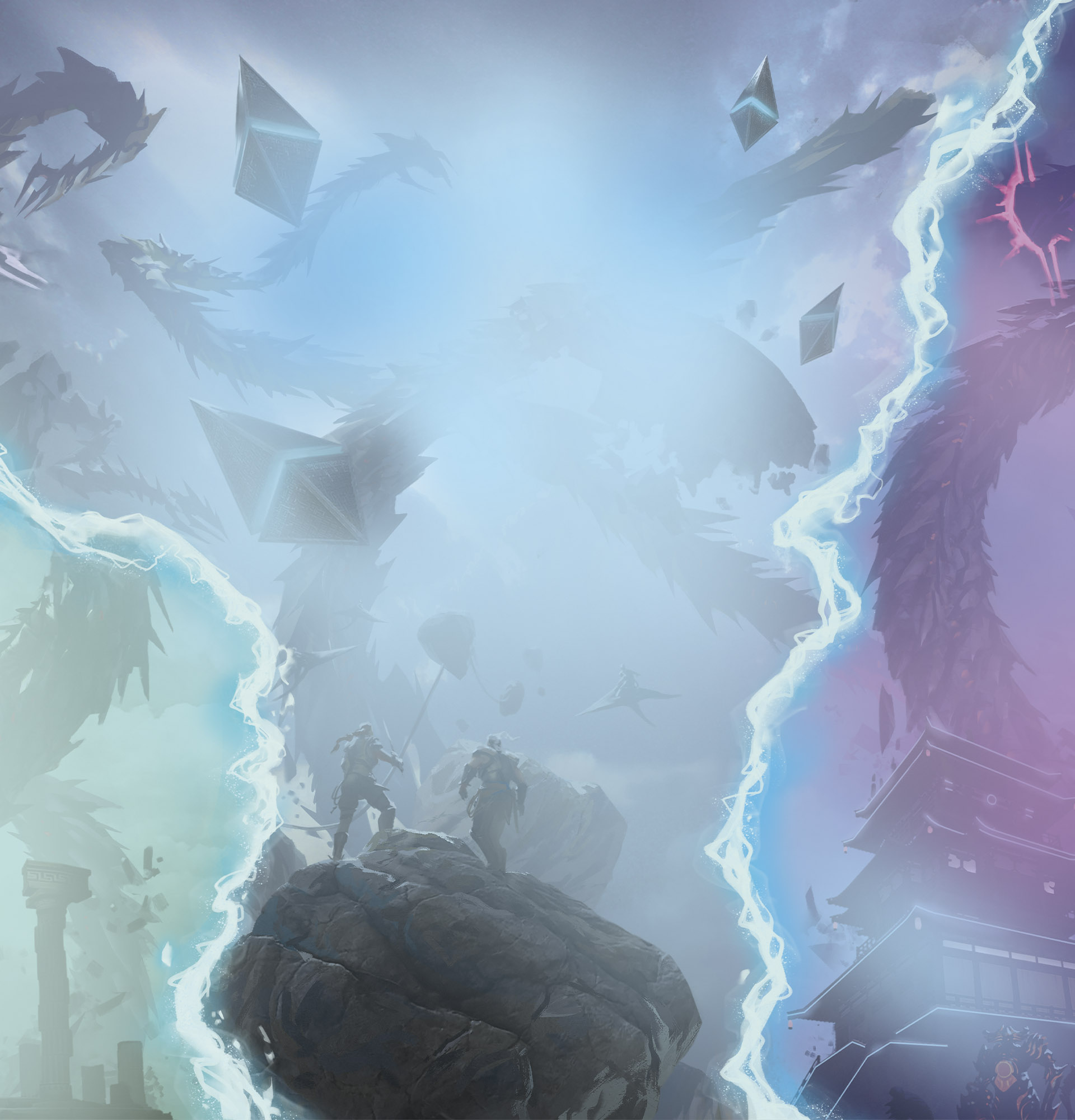
This cosmic phenomenon took the name of the Mending — the Great Repair.
The Mending: The End of the Gods
The Mending was not simply a healing. It was a fundamental transformation of the very nature of magic and planeswalkers. The laws of the Multiverse were rewritten.
The Weakening of the Oldwalkers
Before the Mending, planeswalkers were quasi-divine beings. Immortal. Capable of creating worlds. Of manipulating reality at will. Urza had lived for millennia. Nicol Bolas for tens of millennia. They could change shape, create artificial planes, travel through time. They were gods.
After the Mending, everything changed. The planeswalkers who retained their spark — like Nicol Bolas and Liliana Vess — found themselves dramatically weakened. Bolas himself admitted to having "lost a significant portion of his powers." They remained capable of traveling between planes, but their immortality had evaporated. Their powers now had limits. They could be wounded. Killed. They had become mortal.
To grasp the magnitude of this change, one must measure what the Oldwalkers could accomplish. Urza had lived for more than four thousand years. He had created weapons capable of destroying entire planes. He could rewind time, alter reality, shape living beings out of nothing. Nicol Bolas had ruled an empire spanning multiple worlds for millennia. These beings were gods, with everything that implied — and suddenly, they no longer were.
On the left, the Magus of the Moon, representing the mortal mages who rose to prominence after the weakening of the planeswalkers. In the center, an Aven Riftwatcher, one of the beings who watched over the scars left by the rifts. On the right, Dust of Moments, symbolizing the new ephemerality of beings once eternal.
A New Generation
The Mending did not end planeswalkers — it transformed them. The new sparks that awakened after the Mending created a different kind of planeswalker. These "newwalkers" were mortal from the start. Their powers, while significant, did not make them gods.
It was perhaps better this way. The Oldwalkers, with their unlimited power, had caused as much destruction as good. Urza had triggered the Ice Age. Teferi had phased entire nations. Bolas had destroyed a third of a continent. The new generations would be less... dangerous.
Among the first newwalkers to emerge:
- Jace Beleren — A telepath with a mysterious past, tormented by erased memories
- Chandra Nalaar — A rebellious pyromancer from Kaladesh, unable to control her fiery passion
- Liliana Vess — A necromancer who had made pacts with demons to escape death
- Garruk Wildspeaker — A massive hunter bonded with wild beasts
- Nissa Revane — An elf of Zendikar, connected to the land and mana leylines
And Venser, the artificer of Urborg, became the first confirmed planeswalker of the new era — a symbol of hope for a transformed Multiverse.
The Reckoning: What Was Won and Lost
The Time Spiral and the Mending marked the definitive end of the Era of Rifts.
What Was Lost
- Zhalfir — Phased out of reality, Teferi's homeland remained inaccessible for centuries
- The Oldwalkers — Freyalise, Lord Windgrace, Jeska, Leshrac gave up their existence
- Skyshroud — The entire forest perished with Freyalise, except for a single tree
- Radha's spark — The Keldon warrior lost all planeswalking potential
- Quasi-divinity — The surviving planeswalkers lost their immortality and unlimited powers
What Was Won
- The survival of the Multiverse — Without the Mending, every plane would have been drained of its mana
- The return of Shiv — The continent of dragons reclaimed its place on Dominaria
- Balance — Mortal planeswalkers cause less damage than immortal gods
- Hope — A new generation of heroes emerged, more connected to the worlds they protected
- Humility — The planeswalkers learned that they were not invincible, which pushed them to form alliances rather than acting alone
For Dominaria in particular, the Mending marked the beginning of a slow rebirth. The mana escaping from the rifts ceased to leak. The forests began to grow back. The human kingdoms rebuilt themselves. The plane that had been at the center of so many cosmic catastrophes — the Brothers' War, the Ice Age, the Phyrexian Invasion, the time rifts — could finally know a relative peace.
On the left, Karn, Scion of Urza — though his spark had been sacrificed at Tolaria, he would rediscover it later on Mirrodin. In the center, Teferi, Time Raveler — Teferi would eventually regain his spark years later. On the right, The Mending of Dominaria represents the gradual healing of the plane after centuries of chaos.
The Shadows of the Future
But the Mending also brought new threats.
Nicol Bolas, furious at having been weakened, began to plot for centuries to recover his lost power. The dragon was patient — he had lived for tens of millennia. He could wait. His machinations would lead him to manipulate entire planes, to ignite wars, and ultimately to orchestrate the invasion of Ravnica.
On Zendikar, the barriers weakened by the Mending began to tremble. The Eldrazi — titans of the void imprisoned for millennia — stirred in their sleep. Their chains were weakening.
And in the depths of Mirrodin, the glistening oil that Karn had unwittingly brought was slowly corrupting the metallic world. The Phyrexians would be reborn — not as the servants of Yawgmoth, but as a new threat, even more insidious. This New Phyrexia would not share its predecessor's obsession with flesh; it would embrace metal, mechanical perfection, and above all — a new ability to traverse the planes themselves.
The Multiverse was saved, but new storms were on the horizon. The Mending had resolved the immediate crisis of the rifts, but it had also created a power vacuum. The Oldwalkers who maintained a balance — sometimes brutal, but a balance nonetheless — had vanished or been weakened. In this new Multiverse, ancient threats could resurface, and the traditional protectors no longer had the means to contain them alone.
It is in this context that the newwalkers would have to learn to fight — together, for none of them possessed the power of an Urza or a Bolas. The era of solitary gods was over. The era of mortal heroes was beginning.
Episode 8: The Dawn of a New Era
The Mending changed everything. Discover the first steps of the "newwalkers" — Jace, Chandra, Liliana — in a transformed Multiverse. On Zendikar, the seals of the Eldrazi begin to crack. On Mirrodin, the glistening oil prepares the return of Phyrexia. And Nicol Bolas weaves his web across the planes...
Sources and References
This episode is based on:
- Time Spiral, Planar Chaos, Future Sight — Novel cycle by Scott McGough and Timothy Sanders (2006-2007)
- Time Spiral, Planar Chaos, Future Sight expansions (2006-2007)
- Time Spiral Remastered expansion (2021)
- MTG Wiki — Articles on the time rifts, the Mending, and the planeswalkers involved