- The Hatching: Birth of the First Beings
- Chromium Rhuell — The Metallic Sage
- Arcades Sabboth — The Protector
- Palladia-Mors — Rage Incarnate
- Vaevictis Asmadi — The Hunter
- Tensions Rise
- The Machinations of Nicol Bolas
- Ugin: The Troubled Witness
- War Erupts
- The Twilight of Dragons
- The Scattering
- The Legacy of the War
- In the next episode...
- Sources
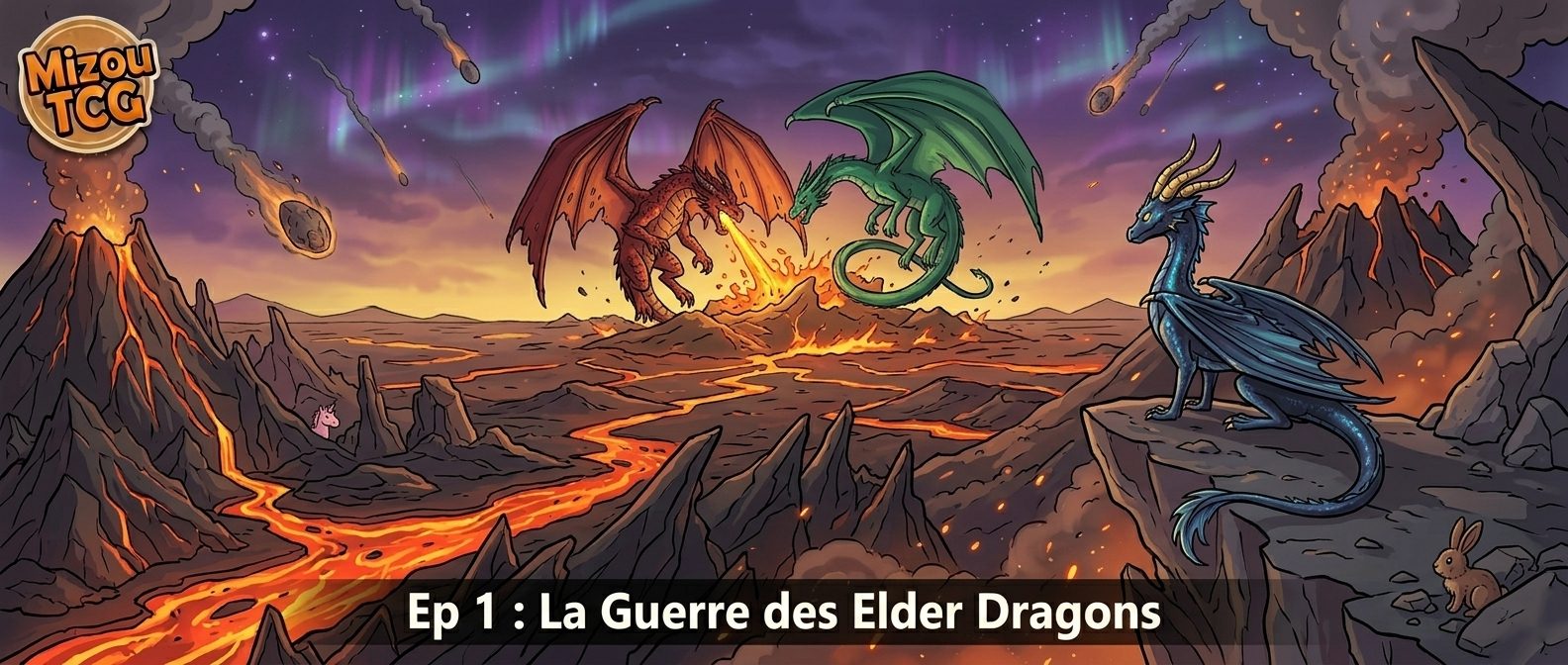
Long before Yawgmoth. Before the Thran. Before even the first humans set foot on Dominaria. In an era when the world was nothing but primitive rock and oceans of cooling lava, eggs fell from the sky — colossal stone-eggs, carriers of primordial life.
Welcome to the first chapter of our exploration of Magic: The Gathering lore. We begin at the very beginning — long before humans, long before civilizations. Discover the personalities of each Elder Dragon, their territories, their alliances — and the machinations of the one who would become the greatest manipulator in the Multiverse: Nicol Bolas.
The Hatching: Birth of the First Beings
The eggs of the Ur-Dragon did not all fall in the same place. Scattered across primitive Dominaria, they landed on different continents — some in active volcanoes, others at the bottom of boiling oceans, still others on mountain peaks battered by cosmic storms.
From each egg was born an Elder Dragon — a creature of divine intelligence and inconceivable power. Unlike the "ordinary" dragons that would emerge later, the Elder Dragons were primordial beings, shaped by the raw energies of creation itself.
Each inherited a unique essence, reflecting the circumstances of its hatching:
Chromium Rhuell — The Metallic Sage
Born in a cavern of metallic crystals, Chromium emerged with scales that shone like living silver. From his birth, he manifested a unique power: the ability to shapeshift.
Where his brothers and sisters saw inferior creatures only as food or nuisances, Chromium chose to study them. He could take on the appearance of a human, walk among the first tribes, listen to their stories, understand their fears and hopes.
This curiosity made him the wisest of the Elder Dragons — but also the most isolated. His brethren considered him strange, detached, incapable of understanding the importance of territory and dominance. Chromium, however, knew that true power lay in knowledge.
Arcades Sabboth — The Protector
Arcades Sabboth was born different. Where most Elder Dragons thought only of conquering, destroying, and dominating, Arcades felt a strange instinct: that of protecting.
He established his territory in a fertile valley, and instead of ravaging it, he fortified it. Stone walls rose at his command, magical ramparts protected the borders. The creatures that lived in his valley thrived — not despite the dragon's presence, but because of it.
His brethren did not understand this apparent weakness. Why protect insects? Why waste energy building walls when one could simply destroy one's enemies? Arcades knew that patience was a far more powerful weapon than brute destruction.
Palladia-Mors — Rage Incarnate
If Arcades represented protection, Palladia-Mors was her exact opposite: destruction incarnate.
She emerged from an erupting volcano, and from her first breath, she reduced everything around her to ashes. Palladia did not seek power, did not dream of dominion — she lived only for violence. The simple act of destroying was her sole source of satisfaction.
Her territory was not a kingdom but a zone of devastation. She never settled twice in the same place, preferring to wander across continents, leaving behind charred lands and rivers of magma.
The other Elder Dragons feared her — not for her intelligence or cunning, but for her unpredictability. No one knew when Palladia would decide that a territory deserved to be reduced to ashes.
Vaevictis Asmadi — The Hunter
Vaevictis Asmadi saw the world through a unique lens: that of the hunt. To him, all existence was a competition, and only the strongest deserved to survive.
Unlike Palladia who destroyed without purpose, Vaevictis hunted with method. He stalked his prey for weeks, studied their habits, learned their weaknesses — then struck with deadly precision.
This predator's philosophy made him formidable, but also manipulable. Vaevictis could be persuaded to hunt any target, provided it represented a challenge worthy of his attention. A weakness that a certain twin dragon would know how to exploit...
Tensions Rise
For centuries, the Elder Dragons coexisted in a fragile peace. Each had their territory, their prey, their concerns. Borders were respected — not out of brotherly love, but out of pragmatism. Confronting an Elder Dragon, even for another Elder Dragon, was a risky undertaking.
But Dominaria's resources were not infinite.
As the Elder Dragons grew in power, their need for mana increased. The territories that once sufficed became insufficient. The ley lines that fed one dragon began to be coveted by others.
The first conflicts were minor — territorial skirmishes, displays of force. But tensions accumulated like pressure in a volcano. All that was missing was a spark.
The Machinations of Nicol Bolas
Among all the Elder Dragons, two were different: Nicol Bolas and his twin brother Ugin. Born from the same egg — a unique phenomenon in the history of Elder Dragons — they were smaller, more fragile than their brethren.
But this physical weakness masked a superior intelligence.
Where the other Elder Dragons saw only adversaries to fight or territories to conquer, Nicol Bolas saw pieces on a chessboard. He understood early on that brute force was not the path to absolute dominion.
Manipulation was.
Bolas began to weave his web with patience. A word slipped here, a rumor planted there. He convinced Vaevictis that Palladia-Mors had hunted on his lands. He suggested to Palladia that Arcades concealed priceless treasures behind his walls. He stoked egos, exploited weaknesses, and watched his brothers and sisters tear each other apart.
All of this without ever revealing his hand.
Ugin: The Troubled Witness
Ugin watched his twin brother with growing unease. He too possessed superior intelligence, but he used it differently — to understand, not to manipulate.
While Bolas orchestrated conflicts, Ugin meditated. He sensed that something existed beyond Dominaria — truths deeper than his brothers' territorial quarrels. This intuition pushed him to withdraw, to seek answers in contemplation rather than in conquest.
But he could not ignore what Nicol was doing. The two twins had confrontations — not physical, but philosophical. Bolas considered manipulation an art, a legitimate means of attaining greatness. Ugin saw in it a corruption of their potential.
This fundamental divergence would plant the seeds of a rivalry that would last millennia.
War Erupts
The final spark came from a confrontation between Palladia-Mors and Vaevictis Asmadi. Manipulated by Bolas's insinuations, the two dragons clashed in a battle that ravaged an entire continent.
Other Elder Dragons took sides. Alliances were formed and broken. Territories changed hands in apocalyptic battles. Primitive Dominaria was ravaged — mountain ranges crumbled, seas evaporated, continents were reshaped by draconic fury.
And amid the chaos, Nicol Bolas maneuvered.
He rarely fought directly. Instead, he helped — offering his assistance to one side, then the other, ensuring the fighting continued, that his rivals weakened one another. When an Elder Dragon was about to win a decisive victory, Bolas intervened... to help the other side.
His goal was not to win the war. It was to ensure that no one would win it.
The Twilight of Dragons
The war lasted centuries. Elder Dragons fell — some killed in battle, others so weakened that they degenerated, losing their divine intelligence to become "ordinary" dragons, powerful but mortal.
In the end, only five Elder Dragons retained their full power:
- Arcades Sabboth — Survived thanks to his impregnable defenses
- Chromium Rhuell — Avoided most conflicts thanks to his ability to shapeshift
- Palladia-Mors — Too destructive to be eliminated, she survived through pure fury
- Vaevictis Asmadi — Weakened but still dangerous
- Nicol Bolas — The great manipulator, who had orchestrated the war from the start
And Ugin, of course. The sixth survivor. But Ugin had not really "survived" the war — he had withdrawn from it. Disgusted by his brother's machinations and the violence of his kin, he had spent most of the conflict in meditation, seeking truths beyond destruction.
The Scattering
Exhausted, the survivors scattered. Arcades returned to his fortified valley. Chromium disappeared among the mortal races, observing the world from the shadows. Palladia-Mors fell asleep in a volcano, her rage temporarily appeased. Vaevictis continued to hunt, but with less fervor than before.
As for Bolas... he had obtained what he wanted. His rivals were weakened, scattered, unable to oppose him. Dominaria was his — not through open conquest, but through the systematic elimination of all opposition.
But one thing tormented him: Ugin. His twin brother, the only being who matched him in intelligence, the only one who had guessed his machinations. As long as Ugin existed, Bolas would never truly be supreme.
This obsession would define the rest of his existence.
The Legacy of the War
The Elder Dragon War was not merely a conflict — it was an apocalypse that shaped Dominaria for the millennia to come.
The fallen Elder Dragons — those who had lost their divine essence — gave rise to draconic lineages that would populate every plane of the Multiverse. Fire dragons, ice dragons, chrome dragons, spectral dragons — all descend, in one way or another, from these primordial titans.
Dominaria itself bore the scars of the conflict. Entire continents had been reshaped. Mountain ranges still bore the marks of titanic claws. Valleys had been carved out by breaths of cosmic fire.
And in the depths of this wounded world, life continued. Mortal civilizations emerged, unaware of the forces that had shaped their world. They would build empires, develop technologies, explore the secrets of mana...
One of these civilizations would call itself the Thran.
But that is a story for another episode.
In the next episode...
Episode 0.2: The Thran Empire
Millennia after the Elder Dragon War, a human civilization reaches unparalleled technological heights. But their grandeur conceals a deadly weakness — a mysterious disease called Phthisis. To combat it, they recall an exiled physician, a genius with radical methods.
His name: Yawgmoth.
And he has plans far more ambitious than a simple cure...
Sources
- MTG Wiki: Elder Dragon War — Complete documentation on the war and its participants
- MTG Wiki: Elder Dragons — History of the Elder Dragons and their lore
- Core Set 2019 (Magic expansion, 2018) — Return of the Elder Dragons in modern versions
- Dominaria United (Magic expansion, 2022) — The saga card "The Elder Dragon War"