
📜 Contents
- The War for Zendikar: When the Multiverse Held Its Breath
- The Refugees and the Flight
- Sea Gate: The Last Bastion
- The Coalition of Survivors
- Ob Nixilis: The Unchained Demon
- The Call of the Gatewatch
- The Confrontation with the Demon
- The Oaths
- Jace's Plan
- The Final Battle
- The Titan of Distortion
- Nissa and the Soul of the World
- The Fire That Consumes Gods
- The Price of Victory
- The Dawn of the Gatewatch
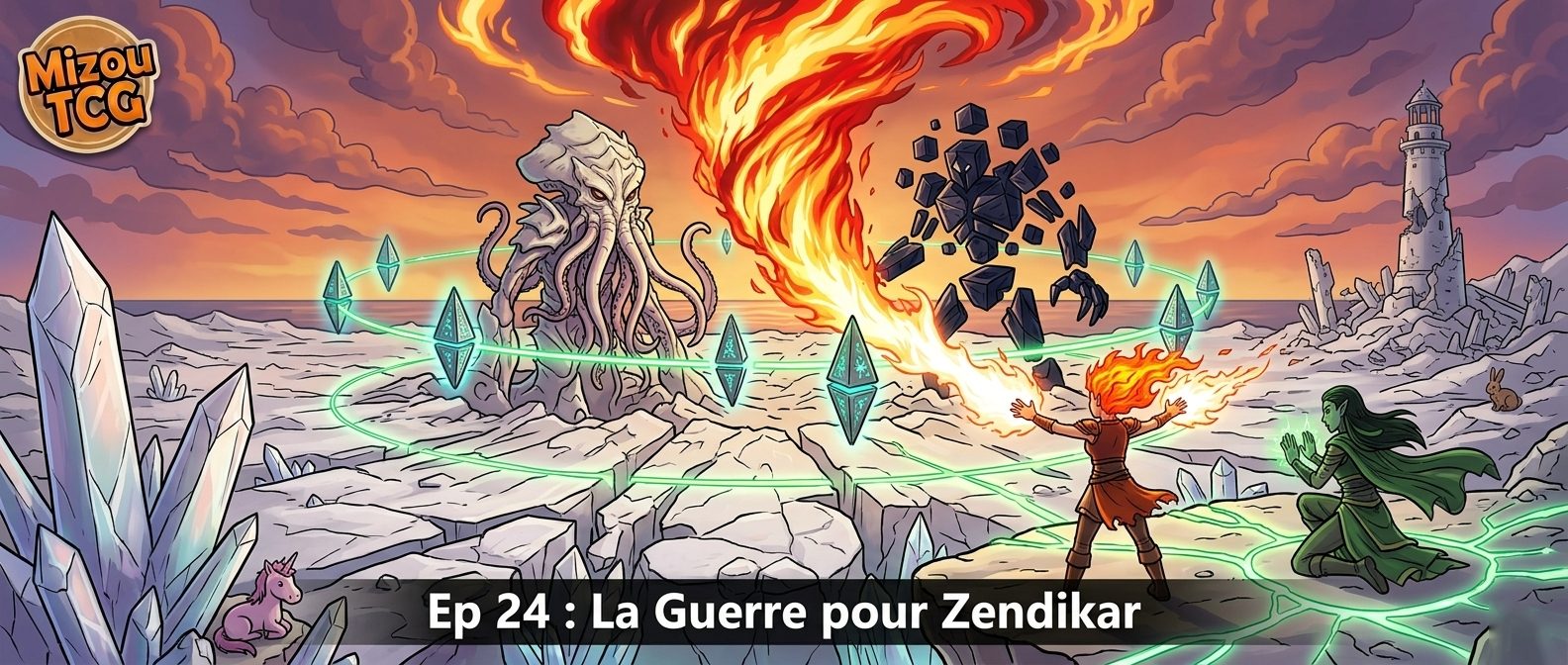
The War for Zendikar: When the Multiverse Held Its Breath
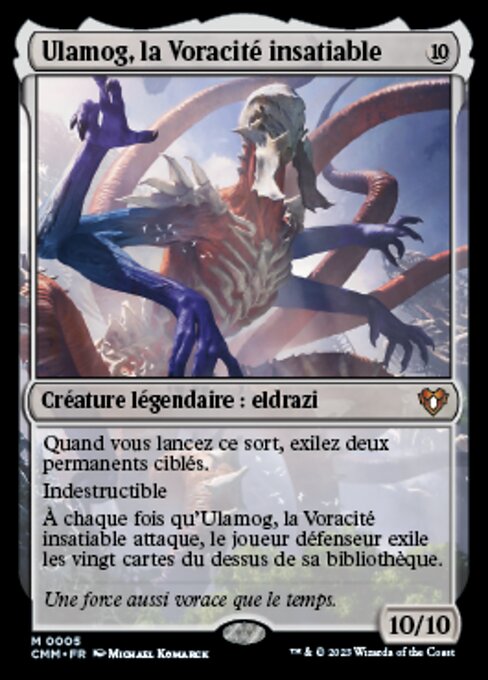
Two years. Seven hundred and thirty days of absolute terror. Since Nissa had shattered the seals of the Eye of Ugin, releasing the Eldrazi titans from their millennial prison, Zendikar had been dying. What had been a wild and dangerous world — a plane where the land itself rebelled against its inhabitants through the unique phenomenon of the Roil — had become a nightmare of cosmic annihilation. The Eldrazi did not simply destroy: they consumed. Every parcel of mana, every spark of life, every fragment of reality disappeared into the void of their insatiable hunger.
The Refugees and the Flight
In the first months of the catastrophe, waves of refugees swept across the still-spared regions. The elves of Bala Ged were among the first to lose their homes, their ancestral forests reduced to white dust in a matter of weeks. The Kor of the highlands abandoned their lines and anchor points, fleeing toward territories they had never inhabited. The merfolk of Halimar saw their coral reefs die, their navigation songs transforming into lamentations.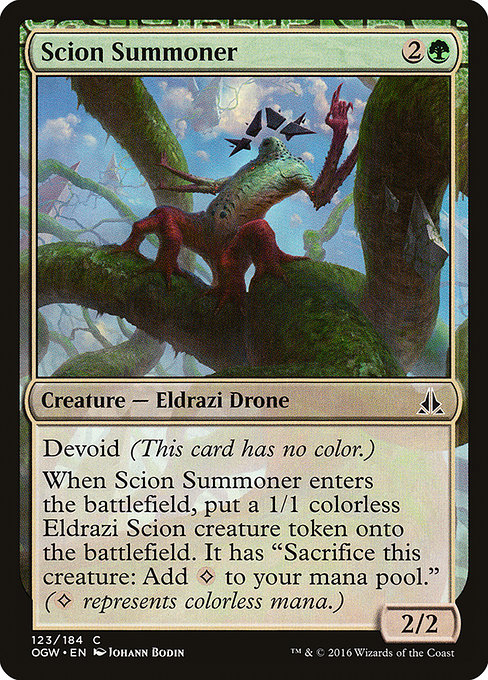
Sea Gate: The Last Bastion
Amid this apocalypse, one man refused to yield to despair. Gideon Jura, the planeswalker whose invulnerability was matched only by his sense of duty, had made Zendikar his cause. Where others would have fled to safer planes — and many had done exactly that, for planeswalkers had that option mortals lacked — Gideon organized the resistance.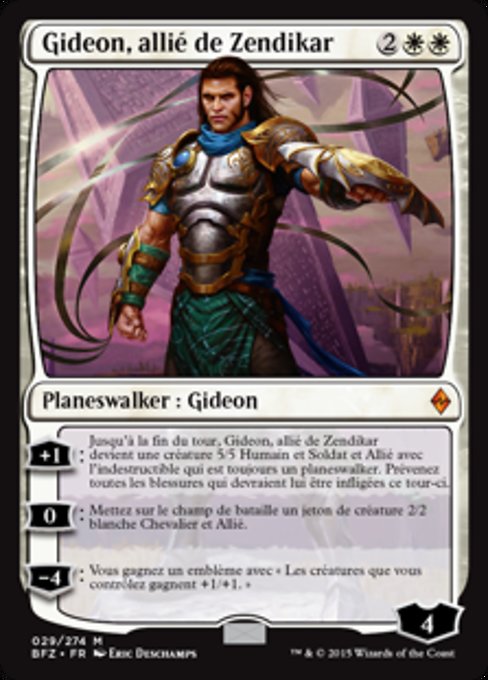
Tazri was a human of exceptional determination, a tactician who had understood before many others that old rivalries between races had to yield before the necessity of collective survival. She had personally negotiated with the leaders of each faction — the Kor elders, the elven matriarchs, the vampire lords — convincing them one by one that their only hope lay in unity.
But even this improbable alliance could not hold forever. Two years after the Eldrazi's release, Sea Gate fell. The city that had been the lighthouse of knowledge and commerce became a field of white ruins, another victim of Ulamog's insatiable hunger. The Lighthouse collapsed, its three centuries of accumulated knowledge reduced to dust.
The Coalition of Survivors
The fall of Sea Gate could have marked the end of all resistance. Many believed it did — that the last bastion of hope had just been extinguished and there was nothing left to do but wait for the end. But Zendikar had always been a world of survivors — beings shaped by centuries of struggle against a hostile environment where even the land could turn against you. The Kor, sky navigators with their hooks and lines, brought their legendary mobility. Capable of crossing the deepest ravines and scaling the steepest cliffs, they served as scouts and messengers, maintaining communications between the different allied forces even when land routes were cut off. The elves of Bala Ged, whose forests had been among the first to fall, fought with the rage of those who have nothing left to lose. Their connection with Zendikar's nature gave them a unique advantage — they could sense the Eldrazi's approach before even seeing them, perceiving the mana being drawn away as an animal senses a predator.
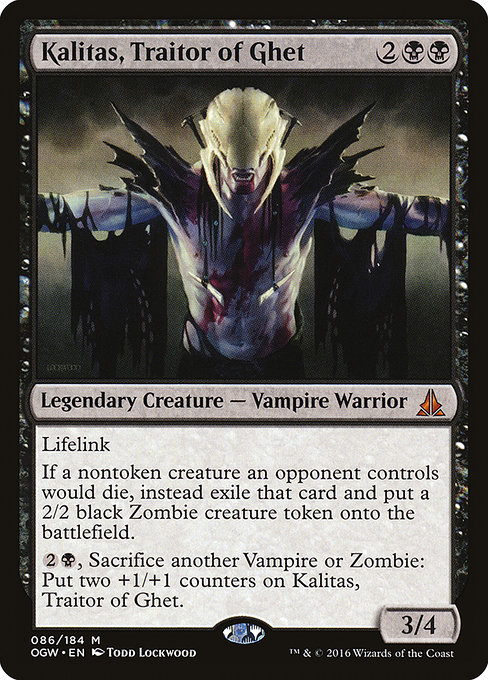
The vampires of Malakir, under Drana's leadership, had chosen to fight alongside their former prey rather than become the Eldrazi's meal. Drana herself was a legendary figure — a vampire of immense power who had survived centuries of conflict. Her decision to join the coalition had been controversial within her own house, but she had argued that the dead cannot feed, and that living allies were worth more than enemies consumed.
Munda, the Kor warchief, coordinated ambushes against the Eldrazi swarms. His tactic was to strike fast and hard, then withdraw before the titans could react. These guerrilla raids could not defeat the Eldrazi, but they slowed their progress, buying precious time to evacuate threatened populations.
Even the goblins, often considered Zendikar's least reliable race, played a crucial role. Zada, a shaman with unique duplication powers, led her bands on suicidal raids against the Eldrazi swarms. Her power allowed her to multiply offensive spells, transforming a single fireball into a hundred simultaneous explosions. These spectacular diversions drew the attention of Eldrazi processors, allowing the main forces to maneuver.
Ob Nixilis: The Unchained Demon
But not all powerful beings of Zendikar fought on the side of life. Ob Nixilis, the former planeswalker turned demon after being cursed by the Chain Veil, had been imprisoned on Zendikar for centuries, unable to escape. His story was one of spectacular fall — once a conqueror of legendary cruelty, he had traversed the multiverse leaving devastated worlds in his wake. Until he met the Chain Veil, a mysterious entity that had inflicted upon him a terrible curse, transforming him into a demon and extinguishing his planeswalker spark.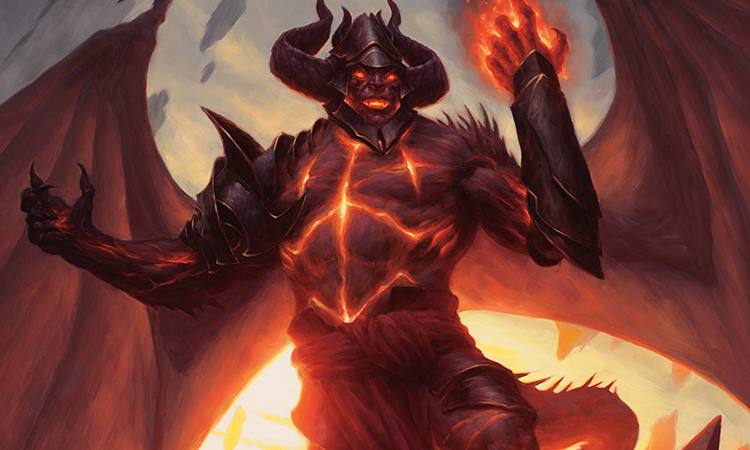
The Call of the Gatewatch
Faced with this double threat — the Eldrazi titans devouring the world and a demonic planeswalker thirsting for vengeance — Gideon understood that no solitary hero could triumph. He needed allies. Not mere fighters, but other planeswalkers, beings capable of understanding what was at stake beyond a single world, individuals whose power could rival that of the threats they faced. Jace Beleren answered the call. The telepath had traversed the multiverse seeking answers about his own nature — his erased past, his fragmented identity, the mysteries surrounding him since he had discovered his gift. But Zendikar's suffering awakened in him something he had almost forgotten in his quest for knowledge: a conscience, a sense of duty toward those who could not defend themselves. Jace was a man of contradictions. His prodigious intellect analyzed the situation with a strategist's coldness, calculating the probabilities of success and failure with mathematical precision. But beneath this facade of detachment, a heart he often refused to acknowledge guided his decisions. He could not simply watch Zendikar die. Not when he had the power to do something. Chandra Nalaar came too, fire and fury incarnate. She who had spent her life fleeing — the Consuls of Kaladesh who had killed her father, the hunters who tracked her, her own guilt at having survived when her family had perished — found in Zendikar a cause worth fighting for. The Eldrazi did not negotiate, did not lie, did not betray. They devoured, simply and purely. Faced with an enemy so absolute in its horror, Chandra's flames finally found a worthy outlet.
And then there was Nissa. Nissa Revane, the animist elf whose mistake had triggered this catastrophe. In the Eye of Ugin, she had believed she was doing the right thing — she had thought that the Eldrazi, once freed, would simply leave Zendikar to seek their food elsewhere. She had been wrong, tragically, catastrophically wrong.
She bore on her shoulders the weight of every life lost, every forest consumed, every child's smile the Eldrazi had erased. At night, in her dreams, she heard the cries of those dying. She saw the faces of those who had trusted in Zendikar, in its natural defenses, and who had been betrayed by her mistake. She could not undo what she had done — no power in the multiverse could — but she could fight so that her mistake would not be the end of everything.
The Confrontation with the Demon
Even before they could tackle the titans, the planeswalkers had to face Ob Nixilis. The demon awaited them, for he had sensed their arrival — the sparks of planeswalkers shone like beacons in the fabric of the multiverse for those who knew how to look. He wanted to destroy them, to savor their defeat before leaving this cursed world.
The confrontation was brutal. Ob Nixilis possessed the power of a planeswalker combined with the physical form of a demon — wings as black as sin, claws capable of tearing reality, and a mastery of black mana that turned death itself into a weapon. Against him, four planeswalkers who barely knew each other, whose powers had never been combined, whose divergent personalities threatened at every moment to divide them.
Gideon served as a shield, his invulnerability absorbing the demon's most devastating assaults. Jace tried to breach Ob Nixilis's mental defenses, but the demon's mind was a labyrinth of pure hatred, so intense that even the multiverse's most powerful telepath nearly lost himself within it. Chandra launched wave after wave of flames, but Ob Nixilis absorbed them, transformed them, turned them back against his attackers.
It was Nissa who made the difference. Her bond with Zendikar allowed her to draw on the plane's own mana reserves, channeling an energy that even the demon could not ignore. The ley lines lit up around her, creating a network of natural power that momentarily neutralized Ob Nixilis's darkness.
Wounded but not defeated, the demon was forced to flee. He swore to return, to take revenge, to destroy everything the Gatewatch sought to protect. But for now, he had underestimated his adversaries, and that mistake had cost him dearly.
The Oaths
After defeating Ob Nixilis in that brutal confrontation that nearly killed them all, the four planeswalkers found themselves before a choice. They could leave, each returning to their wandering life, or they could do something no planeswalker had done since the era before the Mending: commit durably to one another. Gideon spoke first, as befitted the warrior who had carried this cause from the beginning. He knelt in the dust of Zendikar, his hand placed on soil bleached by the Eldrazi, and spoke the words that would define a new era: "For justice and peace, I will keep watch." Jace hesitated. The skeptical telepath, who trusted no one — not even himself, for how do you trust a mind whose history you do not know? — struggled against his instincts. Everything in him cried out to remain distant, not to become attached, to preserve his independence. But something stronger than fear pushed him forward. He spoke words he would never have believed he would say: "For the good of the Multiverse, I will keep watch." Chandra, impulsive and wild, gave an answer that suited her perfectly. No grand phrases, no solemn promises, just a simple truth spoken with the sincerity of fire: "If it means people can live free... yeah, I'll keep watch." And Nissa, the elf who had so many reasons to distrust strangers, who had grown up in a xenophobic people and had learned to count only on herself, opened her wounded heart to these three individuals she barely knew: "For the life of every plane, I will keep watch." Thus were born the Gatewatch. Their name came from Sea Gate, the city they would defend and where they took their oaths. It was more than a team or a tactical alliance. It was a sacred pact, a promise that the multiverse would never again have to face alone the threats that menaced it.Jace's Plan
Defeating Ob Nixilis had been difficult, but the demon was only an obstacle on the path to the true enemy. Destroying the Eldrazi titans seemed impossible — and in the opinion of many, it was indeed impossible. These entities existed beyond mortal comprehension. Their forms on Zendikar were only projections, "fingers" plunged into reality from a being whose true body transcended space itself. How do you kill something that is not truly there?
Jace, however, had a theory. His analytical mind had spent weeks studying the Eldrazi, analyzing ancient accounts, questioning survivors who had seen the titans up close. And he had drawn an audacious conclusion: if the titans were only partially present on Zendikar, why not force them to fully manifest there?
The idea rested on the hedron network — those mysterious stones that the ancients had created specifically to contain the Eldrazi millennia ago. These hedrons were not simple physical prisons; they manipulated the very fabric of reality, creating constraints that affected the higher dimensions where the Eldrazi truly existed.
By reactivating the network and modifying it, one could theoretically anchor the titans to the plane, forcing them to exist fully in physical reality. They would still be immense, still terrifying, still mortally dangerous — but they would be real. And what exists fully in physical reality can be destroyed.
The plan was audacious, perhaps even mad. It required reactivating a hedron network damaged by millennia of neglect and two years of Eldrazi war. It required luring Ulamog into a specific area, holding it there long enough for the hedrons to do their work. And above all, it required hoping that Jace's theory was correct — for if he was wrong, they would not get a second chance.
The Final Battle
Everything began according to plan. Nissa, using her unique connection with Zendikar's soul, reactivated the hedron network. The lines of force that ran through the plane aligned, creating an invisible but powerful trap. It was exhausting work — the animist elf had to maintain her link with thousands of stones scattered across the continent, coordinating their energies with a precision that would have been impossible for anyone who had not grown up in communion with this world's mana. The allied forces lured Ulamog toward the prepared area. It was not a subtle maneuver — the titan of consumption had no strategy in the human sense of the word, only a hunger. The Gatewatch offered it that hunger in the form of living prey, concentrations of mana, anything that could attract its attention. Entire battalions were sacrificed to keep the titan within the planned perimeter. The hedrons lit up. Beams of pure energy converged on Ulamog, enveloping it in a network of magical constraints like the one that had held it for millennia. The titan slowed, its inexorable advance interrupted for the first time since its release. For the first time in two years, it seemed... confused. Weakened. The Gatewatch dared to hope. And then Kozilek returned.The Titan of Distortion
No one had seen it coming. For two years, Kozilek had disappeared, wandering in dimensions mortals could not perceive. Some had hoped it had left Zendikar, drawn to more substantial prey elsewhere in the multiverse. They were wrong. Kozilek, the master of alternate realities and impossible geometries, emerged from the void with a violence that shook the entire plane. Its mere presence warped space — straight lines became curves, distances lost meaning, and the thoughts of mortals fragmented into discordant echoes. Soldiers who saw it first lost their sanity, their minds unable to process what their eyes perceived.
The perfectly black crystals floating above its colossal form absorbed light itself, creating holes in reality that even the eyes of planeswalkers could not endure. Its power corrupted loyalties, clouded thoughts, transformed emotions into despair and panic. Allies turned against one another, suddenly convinced that their comrades were disguised enemies.
The trap designed for one titan wavered under the weight of two. The hedrons crackled with energy overload, threatening to explode. Nissa, maintaining the network by sheer force of will, felt her strength abandoning her. Everything the Gatewatch had built — their laboriously forged alliances, their meticulously planned strategy, their hard-won hopes — seemed on the verge of collapse.

Nissa and the Soul of the World
Nissa closed her eyes. Around her, chaos raged — the cries of the dying, the impossible roar of the titans, the crackling of overloaded hedrons. The world trembled under the weight of two entities that should never have existed in physical reality. But the animist elf was seeking something beyond the noise, beyond the battle. She was seeking Zendikar itself. And Zendikar answered. The plane had suffered, but it was not dead. Beneath the layers of destruction, beneath the bleached lands and dried seas, the heart of Zendikar still beat. The ley lines — those arteries of mana that ran through the world — pulsed with stubborn life, refusing to yield to annihilation. The Roil, that phenomenon which made Zendikar so dangerous and so unique, continued to make the world's heart beat.
Nissa channeled this energy. She became the conduit between Zendikar and the hedrons, merging her consciousness with that of the plane. In this state of total communion, she was no longer simply an elf using green magic — she was Zendikar, and Zendikar was her. She wove the power into strands of pure force, creating a second network that intertwined with that of the hedrons.
The two titans found themselves caught not only in a trap of ancient stone, but in the very embrace of the world they sought to devour. Zendikar held them, refusing to let them go. For the first time in their existence, Ulamog and Kozilek were completely, totally, undeniably present in physical reality.
The Fire That Consumes Gods
Ulamog and Kozilek were trapped, but trapped did not mean defeated. Their titanic forms struggled against their bonds, and with every passing second the network weakened. The hedrons were beginning to crack, Nissa's ley lines wavering under the strain. Action was needed now, or all would be lost. Chandra stepped forward. All her life she had been afraid of her own flames — their intensity, their destructive potential. On Kaladesh, at the execution of her father, her gift had awakened in an unleashing of fire that had nearly killed her own parents in addition to the consular guards. On Regatha, she had learned to control her gift at the monastery of Keral Keep, but a part of her had always held back her fire, fearing what would happen if she truly released it. Not anymore. She drew on every parcel of mana Nissa had gathered. She channeled Zendikar's rage, the pain of its millions of victims, the desperate determination of the survivors. She took everything a dying world could give her, and she transformed it into fire. And she released it all. The fire that burst from Chandra Nalaar was not ordinary. It was not simply fire — it was the anger of a world, focused through the heart of a limitless pyromancer. The flames engulfed both titans, burning not only their physical flesh but their very essence — that part of them that existed beyond Zendikar, in the higher dimensions where they had always been untouchable.
Ulamog screamed — if a being without a mouth can scream. It was a sound that transcended hearing, a vibration that made the soul itself resonate. Kozilek fragmented into impossible geometries, each fragment consuming itself before touching the ground. For an eternal instant, the sky of Zendikar was filled with flames so brilliant they eclipsed the sun, and two of the multiverse's most ancient horrors ceased to exist.
And then, silence.
The Price of Victory
The titans were dead. For the first time in the history of the multiverse, two of the three primordial Eldrazi had been destroyed — not imprisoned as their creators had done millennia ago, not banished to other dimensions, but truly, definitively annihilated. Their material manifestation on Zendikar no longer existed, and if Jace's theory was to be believed, the anchoring to the plane had meant this destruction extended to their entire being. But the victory had a terrible price. Thousands of Zendikari had perished in the final battle — sacrificed to lure the titans, consumed by Chandra's flames, crushed beneath the raging titans. Entire regions of the plane had become deserts of white dust, forever incapable of supporting life. The mana that had animated them had disappeared, drawn in by the Eldrazi before their destruction. And somewhere in the Multiverse, Emrakul — the third and most terrible of the titans — still wandered, destination unknown. The Gatewatch had defeated two out of three threats, but the most dangerous remained free. Sea Gate was rebuilt. Under Commander Tazri's leadership and with the help of the angel Linvala, the city rose from its white ashes in less than a year. The Lighthouse was rebuilt, its walls reinforced, and refugees from devastated regions found a new home within its walls. It would never be the same Sea Gate — too much knowledge had been lost, too many lives sacrificed — but it was a living Sea Gate, proof that Zendikar had survived.The Dawn of the Gatewatch
For the four planeswalkers who had sworn to keep watch, the victory on Zendikar was only a beginning. Their alliance had proven what many believed impossible: that individuals as different as Gideon the protector, Jace the manipulator, Chandra the rebel, and Nissa the recluse could set aside their differences to accomplish the impossible. They had defeated two titans of the void. They had survived Ob Nixilis's treachery. They had proven that union makes strength, even against the most terrifying threats of the multiverse. And they had created something that had not existed since the era of the Oldwalkers: an organization of planeswalkers dedicated to the protection of the multiverse. But other dangers awaited them. Emrakul was still out there, somewhere, and its motivations remained as incomprehensible as its form. Nicol Bolas, the ancient dragon whose machinations stretched across ages and planes, wove his plans in the shadows, manipulating events the Gatewatch could not yet perceive. New worlds called for help, new threats emerged.
The Gatewatch would answer every call. It was their oath, their reason for being, the promise they had made in the dust of Sea Gate. Four planeswalkers — soon more, as others joined their cause — stood between the multiverse and annihilation.
The war for Zendikar was over. But the war for the multiverse had only just begun.
Next episode: "Shadows over Innistrad" — The mystery of Emrakul: Where has the third titan gone? The Gatewatch follows a trail to the gothic plane of Innistrad, where strange mutations begin to affect the inhabitants. Madness spreads, angels become corrupted, and a cosmic horror reveals itself at the very heart of the silver moon. Discover how the guardians of the multiverse faced a threat they could not understand — and the terrible price Innistrad paid for their victory.