
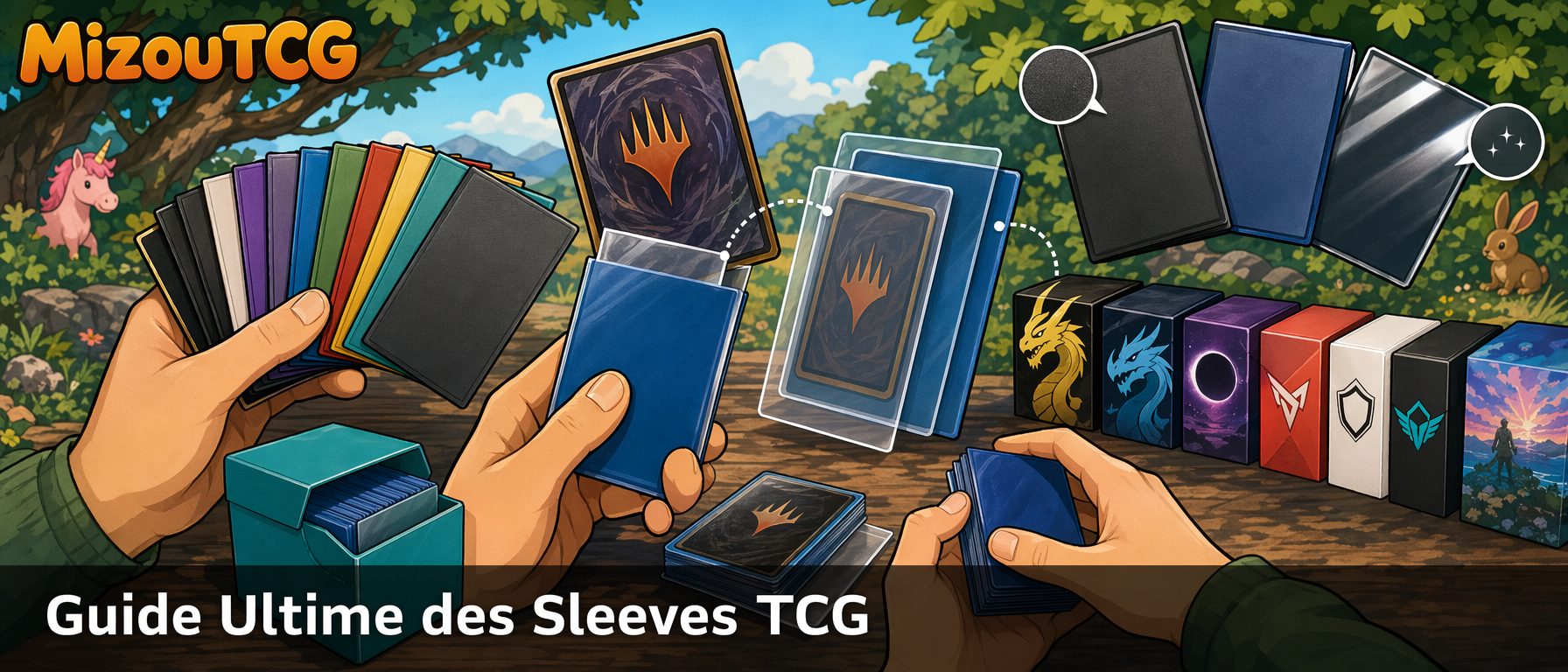
If you play Magic: The Gathering, Pokémon, One Piece, or any other trading card game, one question always comes up sooner or later: which sleeves should I choose to protect my cards? Between the dozens of brands available, the sometimes confusing sizes (standard, japanese, perfect fit), the finishes (matte, eclipse, dual matte, classic), and prices that range from cheap to triple that, it's easy to get lost. And yet, a poor sleeve choice can be costly: scratches, bent corners, moisture, or even depreciation of a rare card you thought was well protected.
This ultimate TCG sleeves guide is designed as a complete hub: we'll break down sizes, compare the major brands, explain the double-sleeving technique used by competitive players, and help you make the right choice based on your usage (casual play, tournaments, long-term collection, Commander deck…). By the end, you'll know exactly which sleeves to order for your next deck, without breaking the bank or sacrificing quality.
Why invest in good TCG sleeves?
You might think a sleeve is just a piece of transparent plastic — classic beginner mistake. In reality, the sleeve is your card's first line of defense against pretty much anything that can damage it: natural oils from your fingers, dust, friction during shuffling, impacts during transport, drink splashes on the gaming table. For a rare Magic card worth $20, $50, or $200, we're talking about an investment of a few cents per sleeve that literally protects a small fortune.
Beyond pure protection, sleeves play a crucial functional role during play: they uniformize the back of the cards so an opponent (or you) can't identify a card by a visible imperfection, they make shuffling easier (bare cards stick together, especially in humid climates), and they make handling smoother during a Commander game that can last two hours.
Physical protection and value preservation
A near mint card without a sleeve that goes through 20 games quickly becomes lightly played, or even moderately played. The depreciation on the secondary market is immediate: we're talking 15 to 40% of value lost depending on rarity and demand. On a Reserved List dual land or a Modern staple, the loss can reach several dozen dollars. Quality sleeves preserve the centering, the corners, and especially the back — the most scrutinized element during professional grading (PSA, BGS).
An asset in play: shuffling, readability, fairness
Modern finishes (matte, dual matte) were designed by and for competitive players: non-slip surface to prevent the deck from fanning out during a riffle shuffle, perfect back opacity to comply with tournament rules, compatibility with double-sleeving for formats where shuffle fairness is critical.
Understanding sleeve sizes: don't get the format wrong
This is the most common mistake among beginner players: buying a sleeve too small or too large for their cards. Each TCG has its own card size, and each card size has its dedicated sleeve. Here's what you need to know.
Standard (66 x 91 mm) — the universal size
This is the format used by the vast majority of Western TCGs: Magic: The Gathering, Pokémon (international versions), Lorcana, Flesh and Blood, One Piece Card Game. If you play Magic, this is always the size you need. Standard sleeves generally measure 66 x 91 mm in inner dimension and are compatible with all classic deck boxes, binders, and playmats. When in doubt, go with standard: you have a 95% chance of being right.
Japanese Size (62 x 89 mm) — for Japanese cards and a few TCGs
A few millimeters smaller, this size is intended for Yu-Gi-Oh! cards, Cardfight!! Vanguard, certain Japanese editions of Pokémon, and as an inner sleeve in a double-sleeving setup (more on that later). Be careful: a Magic card slipped into a japanese sleeve will move around in every direction — this is the classic mistake to avoid.
Perfect Fit (64 x 89 mm) and Outer Sleeves — the specialists
Perfect fit sleeves (or inner sleeves) are ultra-thin sleeves, often transparent, designed to fit a standard card down to the millimeter. Their role: protect the edges of the card in a double-sleeving setup or for long-term binder storage. Outer sleeves, on the other hand, are slightly larger and intended to cover an already-sleeved card (typically a card in a perfect fit) to create the famous two-layer protection.
Finishes: matte, classic, eclipse, dual matte — which to choose?
Once the size is settled, the second major decision concerns the surface finish. This choice directly impacts the feel in hand, shuffling behavior, durability, and aesthetics. Here's an overview of the main options.
Matte: the standard for competitive players
The matte finish has become the tournament norm. With a slightly grainy, non-reflective surface, it absorbs light and limits annoying glare on a tournament table lit by neon lights. Above all, it offers excellent grip: cards slide just enough to shuffle cleanly, without sticking together or forming unstable stacks. It's the default choice for a Modern, Pioneer, Legacy, or Commander deck played regularly.
Dual Matte and Eclipse: the high end
Dual Matte (signature of Dragon Shield) and Eclipse (premium line from Ultra Pro) push the concept further: both faces of the sleeve are matte, with a fully opaque back (often reinforced with an internal black layer for Eclipse) that prevents any unintentional marked card. Ideal for sanctioned tournaments where judges scrutinize back uniformity. Eclipse opacity is reputedly unbeatable.
Classic / Glossy and Art Sleeves: aesthetics
Classic finishes (or glossy) are shiny, very smooth, and showcase the card's art. They're perfect for displaying a beautiful foil in a showcase or for a casual deck at home, but much less suited to intensive shuffling (cards slide too much). Art sleeves, meanwhile, feature an illustration on the back: characters, landscapes, guest artists (Secret Lair from Magic, collaborations with illustrators like Akira Toriyama or Yoshitaka Amano). They personalize your deck but generally remain in classic or light matte finish.
Comparison of major brands: Dragon Shield, Ultra Pro, KMC, Konix
The French market is dominated by three big names, each with their strengths and weaknesses. Here's our honest comparison, based on hundreds of decks built and tested.
Dragon Shield: the quality/price reference
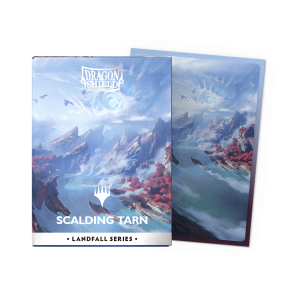
A cult Danish brand among Magic players, Dragon Shield offers an extremely complete range: classic Matte, Dual Matte, Matte Art, Perfect Fit, Japanese Size, not to mention the famous color-coded matching deck boxes. Their Matte finish is considered by many to be the best on the market for shuffling, and the plastic thickness offers reassuring rigidity. Expect to pay $10 to $13 for 100 standard sleeves. The color palette is huge (over 40 shades), allowing you to match each deck to its Commander identity.
Ultra Pro: the premium alternative with Eclipse
An American TCG giant, Ultra Pro is a must, especially thanks to its Eclipse line: 100 sleeves per pack (vs 80 to 100 for Dragon Shield depending on the line), maximum opacity, high-quality matte finish, and slightly superior rigidity that appeals to very meticulous players. Ultra Pro also produces officially licensed Magic and Pokémon sleeves, with art from recent sets. Price range similar to Dragon Shield: $11-$14 for 100 Eclipse sleeves.
To compare the lines concretely, here's a selection of our most popular Dragon Shield products:



KMC, Konix and other alternatives
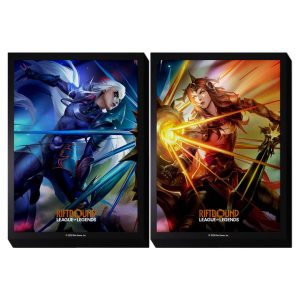
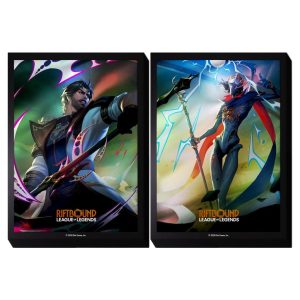
For licensed games like Riftbound, specialized publishers (UVS Games) release dedicated sleeves: the Sleeves Spirit Blossom Teemo Esprits Forgés - 100 - Riftbound (16,20€) illustrates this new wave.
KMC (Japanese) is historically the favorite brand of Yu-Gi-Oh! players and many Japanese Magic pros. Excellent Hyper Matte line, predominantly japanese size format, and a reputation for unmatched durability (some players keep their KMCs for over 500 games). A bit harder to find in France, but highly prized by purists. Konix positions entry-level sleeves at low prices for casual players, kids, or draft sessions where you sleeve 40 cards quickly. Decent quality, but you can feel the difference over time.
Double-sleeving: an advanced technique to protect your valuable cards
If you own high-value cards (dual lands, fetches, Bowmasters, Ragavan, One Ring, Reserved List cards, Alpha/Beta/Unlimited…), double-sleeving quickly becomes essential. The principle: a first thin sleeve (perfect fit) in direct contact with the card, then a second standard sleeve (outer sleeve) over it. Result: two layers of protection, no moisture intrusion, impossible for dust to scratch the edge.
Why double-sleeve: the three key arguments
1) Reinforced edge protection: that's where cards get damaged the most. The perfect fit literally seals the card. 2) Centering stability: the card doesn't move inside its outer sleeve, which prevents corner friction. 3) Maximum opacity at tournaments: two layers = perfectly uniform back, no risk of marked card. This is the official setup for the majority of Legacy and Vintage players, where decks are sometimes worth more than $10,000.
Steps to double-sleeve properly
Step 1: Insert the card into the perfect fit sleeve, opening facing down. This prevents dust from entering through the top during play. Step 2: Slide the assembly (card + inner sleeve) into a standard outer sleeve, this time opening facing up (normal configuration). Step 3: Push out residual air by gently pressing from bottom to top. The final deck will be a bit thicker than with single sleeving (expect a slightly larger deckbox), but the protection is incomparable. For a detailed tutorial, check out our step-by-step double-sleeving guide.
Art sleeves, customization and the visual identity of your deck
Once function is mastered, it's time for form. Art sleeves have become, in just a few years, a visual identity element in their own right: matching your deck's commander with a thematic illustration, displaying your Ravnica guild colors, or simply standing out at a tournament with a collector sleeve. Wizards of the Coast got the message and is multiplying Secret Lair products with exclusive sleeves.
Where to find quality art sleeves?
Three main sources: officially licensed sleeves (Ultra Pro produces official Magic sleeves for each set, with art from the box topper or an iconic card), artist series (Dragon Shield Matte Art, Ultra Pro Artist Series), and limited Secret Lair editions distributed directly by WotC. Watch out for the finish: many art sleeves are in classic/glossy and slip more than a matte — best reserved for casual play or to be protected via double-sleeving with a perfect fit inner.
Don't forget the deck box, binder and playmat
Sleeving is good. But without a suitable container, sleeves wear out, cards fall out, and storage becomes a nightmare. A good deck box sized to your sleeved deck (watch out for double-sleeved formats which take up more space), a binder/portfolio with side-load pockets to display your binder of rares, and a playmat to play on a clean surface are the natural complements. It's a whole ecosystem to build, and we've published dedicated guides for each accessory category.
Articles in this guide
Guide Ultime des Sleeves TCG
Pilier central sur les protections de cartes : choisir ses sleeves, marques, tailles, finitions, double-sleeving et entretien.
FAQ – Frequently Asked Questions
What is the best sleeve brand for Magic: The Gathering?
There's no single answer, but Dragon Shield Matte and Ultra Pro Eclipse are the two consensus references in 2026. Dragon Shield offers a better quality/price ratio and an unmatched color palette; Ultra Pro Eclipse stands out for legal opacity and superior rigidity. For a first purchase, go with Dragon Shield Matte — you won't be disappointed.
How many sleeves should I buy for a Commander deck?
A Commander deck contains 100 cards. So you need at least one pack of 100 sleeves. We recommend buying two packs (200 sleeves) to have spares in case a sleeve gets torn during a game, and to sleeve sideboard cards or future deck updates. For double-sleeving, double the quantity: 200 sleeves for a 100-card deck.
Matte or glossy: which finish to choose?
For playing: matte, no question. Shuffling is cleaner, glare is reduced, and wear is slower. To display a card in a showcase or a collection binder: glossy/classic, which better highlights the art and foils. Many players use both: matte for decks, glossy for the rares binder.
Can double-sleeving damage my cards?
No, provided you use quality perfect fits (Dragon Shield, KMC, Ultimate Guard) and respect the orientation: inner sleeve opening facing down, outer sleeve opening facing up. An orientation mistake or a too-tight perfect fit can slightly crease the corners on removal. Under normal use, double-sleeving protects far more than it damages — it's the norm among Legacy and Vintage players.
How often should sleeves be replaced?
It depends on play frequency. For a deck played once a week, quality Matte sleeves easily last 6 to 12 months without visible wear. Signs that it's time to change: visible scratches on the back, whitening corners, deformed opening, surface becoming sticky. A competitive player changes sleeves before each major tournament as a precaution.
Can foil cards be sleeved without damaging them?
Yes, but with care. Magic foils tend to curl slightly with humidity. A rigid matte sleeve (Dragon Shield, Eclipse) helps keep the card flat. For high-value foils (Serialized, Borderless foil), double-sleeving with a perfect fit is strongly recommended: it stabilizes the card and limits deformations caused by ambient air.
Conclusion: sleeve well, play well, collect well
Choosing your TCG sleeves is not a trivial decision: it's a long-term investment in protecting your cards, gameplay comfort, and even the visual identity of your decks. In summary: go with standard size for Magic, a matte finish for regular play, a recognized brand (Dragon Shield or Ultra Pro Eclipse) for durability, and consider double-sleeving as soon as you play high-value cards. The rest — color, art, customization — is a matter of taste.
Ready to gear up your next deck? Discover our complete selection of sleeves available in stock at MizouTCG, with fast shipping in France:


And to go further, check out our complete guide to choosing a deck box to round out your end-to-end protection setup.
Products recommandés