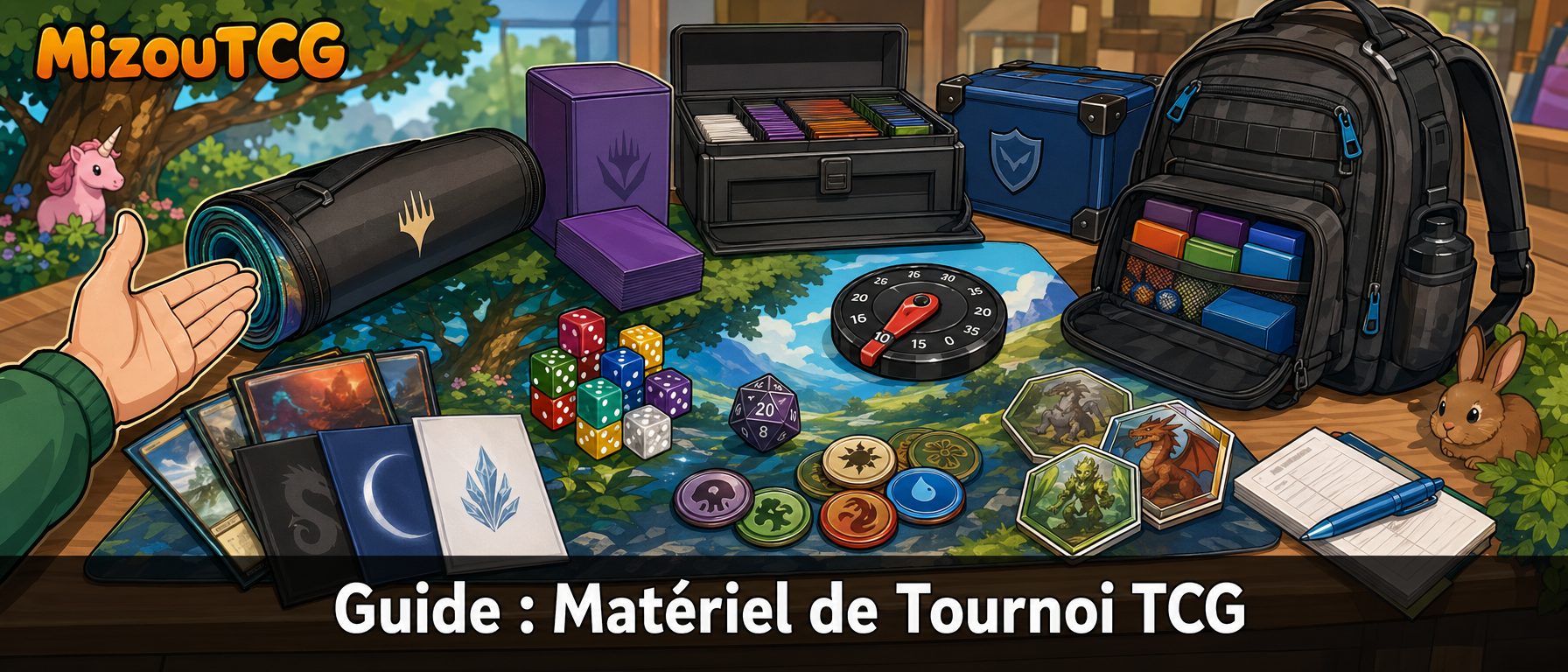
A Magic tournament is much more than a well-built deck. Between back-to-back rounds, judge checks, deck checks, and the fatigue of an eight-hour day, your equipment often makes the difference between a smooth experience and a frustrating one. A slipping playmat, dice lost at the bottom of your bag, tokens forgotten at home: these small details can cost you a game or simply break your concentration.
This guide covers the essential equipment for playing in TCG tournaments, primarily Magic the Gathering, but also Pokémon, One Piece, Lorcana, and Wakfu. We cover the playmat, dice and life counters, tokens and markers, tournament sleeves, storage and transport, and even the perfect bag checklist. The goal: give you genuinely useful recommendations, not SEO filler.
Whether you're preparing for your first FNM (Friday Night Magic), a Prerelease, a PPTQ, or simply your local shop's weekly evenings, you'll find the basics here for gearing up intelligently — and the nuances that mean you'll never arrive at the table without a d20 again.
The playmat: the surface that changes everything
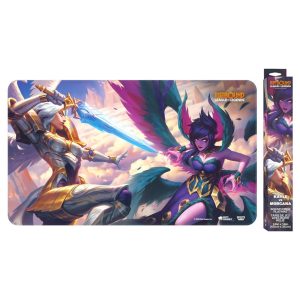
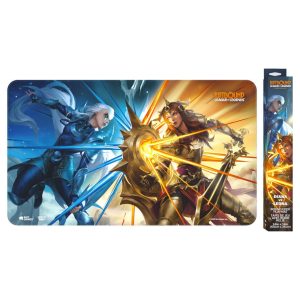
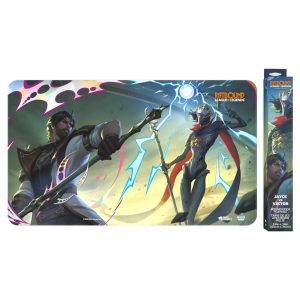
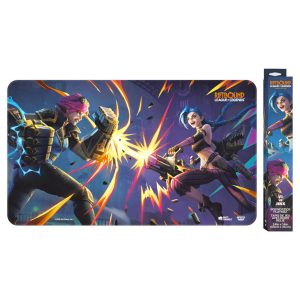
The play mat, or playmat, is arguably the most iconic accessory for a TCG player. Beyond the cosmetic aspect, it serves three very concrete functions: protecting your cards from friction on the worn tables of tournament halls, providing a non-slip surface while you shuffle, and visually delimiting your play area — a point that judges appreciate when they move between tables.
Dimensions and materials
A standard playmat for Magic measures approximately 60 cm wide by 35 cm deep, which leaves room for the library, graveyard, exile, sideboard, combat zone, and lands. The base is generally made of neoprene or a few millimetres of thin foam, with a woven surface that lets sleeved cards glide without scratching them. The smoother the surface, the better the cards slide when you tap or pivot your permanents repeatedly — a detail that matters over 8 rounds of an intense day.
Is a playmat really necessary in a tournament?
Officially, no — no Wizards of the Coast rule requires it. But in practice, from your very first serious tournament, you'll notice that nearly all players use one. The reason is simple: without a playmat, matte sleeves end up getting scratched on tables that have seen thousands of players pass through, and shuffling properly becomes unpleasant. Budget between €15 and €40 for a decent playmat; special artist editions or official MTG licences (sets, iconic planeswalkers) can go up to €60-80.
Transport tube: essential
A folded playmat is a playmat marked for life. The folds show and the fabric can tear along the crease. Invest in a rigid transport tube (often sold with the playmat or around €10-15 separately) or a dedicated carrying case. Roll the playmat with the surface facing inward — this protects the woven area from friction during transport.
Dice, life counters, and tracking
Tracking life points is mandatory in a sanctioned tournament. Judges can ask you at any time how many HP you have left, and both players must agree on the value. Poor life tracking is one of the most common causes of disputes during a game, and can result in a game loss at Competitive REL if the gap between the two players is too large to reconcile.
Die, paper, or app?
Three schools of thought coexist. The d20 is the classic option: practical, fast, but imprecise once you exceed 20 HP or chain several rapid changes. You then need to place a second die for the multiplier (10, 20, 30...), and confusion arises quickly. Paper and pen is the official method at high-level competitions (Pro Tour, Regional Championships): zero ambiguity, complete traceability of changes, perfect for reconstructing a game in case of a dispute. Finally, apps like MTG Familiar or Untap let you track multiple players simultaneously (useful in Commander), but are sometimes prohibited at Competitive REL depending on the head judge — always ask at the start of a round.
Which dice to buy?
For Magic, plan at minimum:
- 2 d20 dice (one for each player's life, or to track poison/energy)
- An assortment of d6 (5 to 10) for +1/+1 counters on creatures and various markers
- A few d8 or d12 for decks with special counters (high planeswalker loyalty, charge on artifacts)
Transparent dice with clearly readable numbers are preferable to "fancy" dice where 6 and 9 look identical — a detail that will save many disputes mid-tournament. Also avoid very small dice (under 12 mm) that get lost under cards.
Spinner vs classic d20
The spinner die (often called a "life counter dial") is a rotating disc that displays a number up to 50 or 99. It turns without needing to be re-rolled, which drastically reduces tracking errors above 20 HP. It's an excellent purchase for Commander players (starting life: 40) or for Standard lifegain decks. Budget €8-15 for a quality spinner.
Tokens and markers
If your deck generates creatures (elementals, soldiers, zombies, goblins, treasure tokens, food, clues...), you need physical tokens. Judges tolerate "proxy tokens" (turned-over cards, coins, annotated paper) at Regular REL, but in competitive tournaments, official tokens or standard-sized printed cards are strongly recommended — otherwise your opponent can ask the judge for a zone clarification.
Where to find tokens?
Three main sources for Magic:
- MTG Boosters: each Play Booster contains a token (on the back side of an ad-token card). Opening a display generally leaves you with 36 varied tokens.
- Single purchase: on marketplaces (CardMarket) or in shops, budget €0.10 to €0.50 for a common token, up to several euros for promo or foil tokens.
- Event promo tokens: distributed at Prereleases, FNMs or Store Championships, often in textured format.
To choose your boosters wisely, see the MTG display buying guide.
Counters and visual indicators
Beyond creature tokens, you'll need visual markers for +1/+1 counters, poison or energy counters, charge counters, and the ability stack. Transparent dice in different colours do the job in 95% of cases — a red die for the stack, a blue die for +1/+1 counters, a green die for charge, etc. For Energy, +1/+1, or Infect decks, some players invest in metal or acrylic counters with engraving: elegant, but far from necessary to play well.
Tournament sleeves: the non-negotiable base
No tournament sanctioned by Wizards of the Coast allows an un-sleeved deck. Beyond the rule, sleeves protect your cards from repeated handling (one Modern round easily accumulates 200 cumulative shuffles) and preserve their resale value. In a tournament, two additional requirements come into play: back opacity (no unintentional marking that would allow identifying a card without turning it over) and total uniformity (all sleeves in your main deck and sideboard must be strictly identical).
Which finish to choose for tournaments?
Matte finish is the most widespread choice among competitive players: fewer reflections under tournament hall lighting, better shuffle, a "new" look that lasts longer than glossy. Classic/Glossy finish remains popular for casual play but can shine under lights and mark more visibly. For Magic, Pokémon, or One Piece, the Standard 66×91 mm format covers all main cards. For Japanese cards (Pokémon JP, Yu-Gi-Oh!), use Japanese Size 62×89 mm.
For more on selecting a finish suited to your player profile, see the ultimate TCG sleeves guide.
Recommended brands in French tournaments
Three brands dominate tournament tables in France:
- Dragon Shield Matte: ~€12 per 100 standard sleeves, durable, perfect opacity, excellent shuffle. The reference for Modern and Legacy players.
- Ultra Pro Eclipse Matte: ~€13 per 100 sleeves, very matte finish, dark-tinted back for maximum opacity. Widely used on the circuit.
- KMC Hyper Mat: standard for players coming from Yu-Gi-Oh! and increasingly used for Magic.
For a detailed face-off between these three brands, read the Dragon Shield vs Ultra Pro vs KMC: Sleeve Comparison.



Double-sleeving for valuable cards
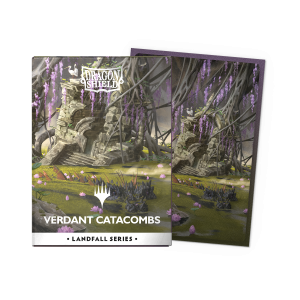
For Modern, Legacy, or Vintage decks containing cards worth more than €30 (fetchlands, dual lands, Reserved List originals), many players use double-sleeving: a transparent perfect-fit inside, then a standard matte outside. The technique doubles the thickness, better protects the edges, and limits wear. As long as all outer sleeves are identical, it's perfectly legal in tournaments. Details in the dedicated guide on why and how to double-sleeve.
Storage and transport: from bag to table
Arriving at a tournament with a disorganised bag means losing 5 minutes every round rummaging for your tokens, notepad, or coloured dice. Multiplied by 8 rounds, that's nearly an hour lost — not counting the stress of searching while the clock ticks and your opponent waits.
The deck box: first essential
For a Standard, Pioneer, or Modern deck (60 cards + 15 sideboard, all sleeved), a rigid deck box of 100+ cards is sufficient. For Commander (100 cards in sleeves, no sideboard), you need a larger box, capacity 120+ or 130+. For players transporting multiple decks or a voluminous testing sideboard, trunk boxes (200, 400, or 800 cards) with separate compartments are the solution. Reliable brands: Ultimate Guard, Ultra Pro, Dragon Shield, Gamegenic.
The tournament bag: organisation over brand
You don't need an overpriced specialised bag: a rigid backpack with compartments does the job perfectly. But prioritise:
- A rigid or semi-rigid compartment for the playmat rolled in its tube (otherwise it bends)
- A zipped inner pocket for dice (otherwise they scatter throughout the bag)
- A flat slot for the portfolio (binder) if you're transporting a testing sideboard or cards under evaluation
- A quick outer pocket for the paper decklist and notepad
For a complete overview of deck boxes, trunks, and portfolios, see the TCG storage and transport guide.
The perfect tournament bag checklist
Here is the exhaustive list of what every competitive TCG player should have before heading to a sanctioned tournament. Print it, tape it inside your deck box, or save it on your phone.
Essentials (without these, you don't play)
- Sleeved main deck (60 cards Standard/Modern, 100 Commander)
- Sleeved sideboard (15 cards, sleeves strictly identical to the main deck)
- Completed and signed paper decklist (in duplicate if the organisation requires it)
- Minimum 2 d20 dice (+ assortment of d6)
- Pen + paper or life tracking app
- Tokens for all creatures and markers generated by the deck
- Playmat in its transport tube
- Deck box or trunk to transport the deck
- Photo ID (required for verification at Wizards Competitive-level tournaments)
Very useful (secures the day)
- Pack of identical replacement sleeves (in case of marking during a round)
- Water bottle and energy bar (sandwiches are rare)
- Printed deck list for reading between rounds
- Notepad for analysing matches and tracking the sideboard
- Charged phone + charger or external battery
Nice to have (the inner coach)
- Dedicated poison, energy, or loyalty counter for specific decks
- Magnifying glass for reading foreign or damaged cards
- Secure transport sleeve for valuable cards (fetchlands, planeswalkers, originals)
- Earplugs or headphones (tournament halls can be noisy)
Articles in this guide
This pillar guide introduces the basics of TCG tournament equipment. For a deeper dive on any specific aspect, the cluster's detailed guides go further:
- The best accessories for TCG tournaments: detailed product selection by category
- Ultimate TCG sleeves guide: everything you need to know before buying
- TCG storage and transport: deck box, portfolio, trunk
- Double-sleeving: why and how: maximum protection
- How to start Magic the Gathering: for players about to play their first tournament
FAQ – Frequently asked questions
Is a playmat mandatory in a tournament?
No, no official Wizards of the Coast rule requires it for Magic. But protecting matte sleeves that cost at least €12 on worn tables is common sense, and all regular players use one. Think of the playmat as a long-term investment: a good mat lasts several years.
Can you use an app to track life in a tournament?
At Regular REL (FNM, Prerelease, Store Championship), apps are generally tolerated. At Competitive REL (PPTQ, RCQ, Regional Championship) or Professional (Pro Tour, Worlds), pen and paper are mandatory to allow reconstruction of a disputed game. When in doubt, always ask the head judge at the start of the round.
How many tokens should you bring?
Enough for the maximum quantity your deck can simultaneously generate in play. A Bogles deck needs no tokens; a Modern Elementals deck or a Standard Tokens deck can easily have 8 to 12 creature tokens active at the same time. Count "the worst case scenario" and round well above to avoid having to improvise with a proxy mid-round.
What's the difference between a d20 and a spinner die for life tracking?
A classic d20 requires re-rolling or moving the die with every HP change: practical at the start of a game, awkward above 20 HP where you need to add a second multiplier die. A spinner die (with integrated counter, up to 50 or 99) rotates to adjust HP while staying in place, with no risk of "losing" the value. More precise, especially in Commander where the starting life total is 40, but also bulkier and more expensive (€8-15 vs €1-2 for a simple d20).
Are double sleeves allowed in tournaments?
Yes, provided the outer sleeves are all strictly identical and opaque on the back. Double-sleeving is widely used for Modern, Legacy, and Vintage decks containing expensive cards (fetches, duals, Reserved List). The transparent inner perfect-fit is not considered a sleeve in its own right by judges — it's the outer sleeve that counts for uniformity.
Can you play in a tournament with already-marked sleeves?
No. A marked sleeve (visible scratch, damaged corner, deformation, reduced opacity) creates a potential advantage: the player can identify certain cards in their deck without turning them over, which is treated as cheating at Competitive REL. Judges conduct random sleeve checks between rounds, and a thorough deck check can result in a game loss or even a match loss. At the slightest doubt about sleeve condition, bring a new pack of identical sleeves in your bag and re-sleeve before the tournament.
Should you insure your equipment for tournaments?
For everyday equipment (playmat, dice, deck box, sleeves), no — the total value rarely exceeds €100. However, for decks containing valuable cards (Modern, Legacy, Vintage, Commander cEDH), a Modern deck can represent €1,000 to €3,000 in cards. Some players take out a home "nomadic items" multi-risk insurance that covers these amounts in case of theft or loss. Check your policy conditions before travelling to a Regional Championship.
Conclusion: smart equipment, serene day
Equipping yourself for TCG tournaments is less a question of budget than of consistency: uniform and opaque sleeves, visible and properly sized dice, up-to-date tokens, organised bag, protected playmat. Most of this equipment is a long-term investment — a good playmat lasts five years, transparent dice are nearly eternal, a rigid deck box handles years of intensive transport.
The classic beginner mistake is buying everything new and top-of-the-range for the first FNM. The right approach: start with the essentials (standard matte sleeves, rigid deck box, 2 d20 dice, €20 playmat), play 10 tournaments to identify your real preferences, then refine with targeted purchases. After a year, your setup will be adapted to your style of play rather than copied from someone else's.
To explore our selection of Dragon Shield sleeves, Ultra Pro, deck boxes, and tournament accessories, visit the Dragon Shield selection or browse the entire accessories selection of the moment.
Products recommandés