
The Assassin creature type has existed since Limited Edition Alpha (1993), but for a long time it lacked the cards to carry an entire deck. Universes Beyond: Assassin's Creed, released on July 5, 2024, changed everything: it massively expands the type and introduces the freerunning mechanic, finally making the Assassin typal deck viable in Commander. EDHREC dedicates a full guide to it; here's the essential rundown for choosing your commander, understanding its key cards, and protecting your deck.
Assassins, a Type as Old as Magic: From Royal Assassin (1993) to Assassin's Creed (2024)
The game's very first Assassin, Royal Assassin, appears in Limited Edition Alpha, the founding set of August 1993. Its ability alone sums up the spirit of the type: "{T}: Destroy target tapped creature." A formidable control threat against creatures that, back then, almost all had to tap in order to attack.
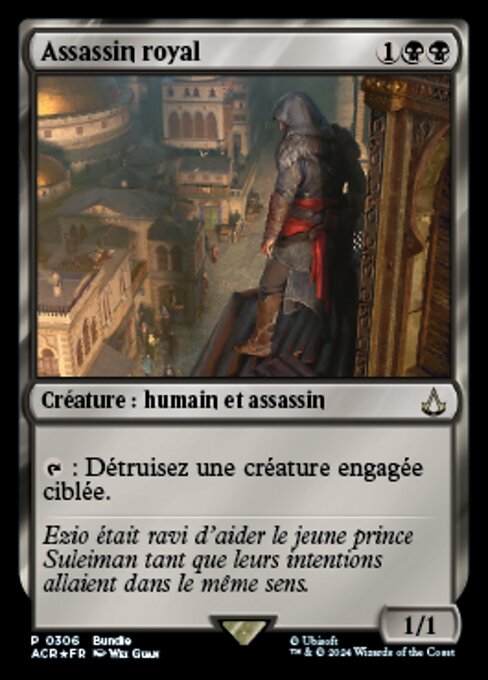
The catch, for nearly three decades: Wizards printed too few Assassins to build a coherent typal deck. Royal Assassin was played as a standalone piece, never as the head of an archetype.
Universes Beyond: Assassin's Creed, released on July 5, 2024, overturns that. The first set to use Beyond Boosters, it adds a wave of playable Assassins — creatures, commanders, and payoffs — that finally raises the type to a viable archetype in Commander.
Which Commander for an Assassins Deck? Ezio, Ramses, Queen Marchesa & Co.
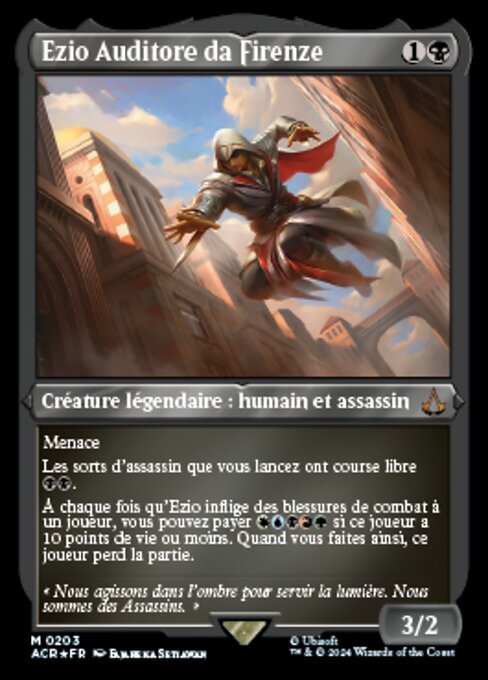
The choice of commander shapes the entire deck. On EDHREC, the most popular in the archetype at the time of writing is Ezio Auditore da Firenze: a five-color identity, cost reduction via freerunning, and an alternative win condition able to close out the game when he hits an opponent already at a low life total.
Several "lords" and payoffs then structure the archetype:
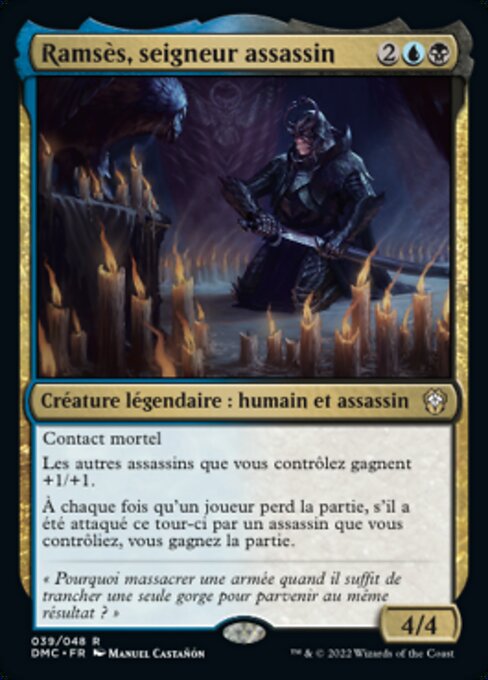
- Ramses, Assassin Lord — gives +1/+1 to your Assassins and brings its own alternative win condition.
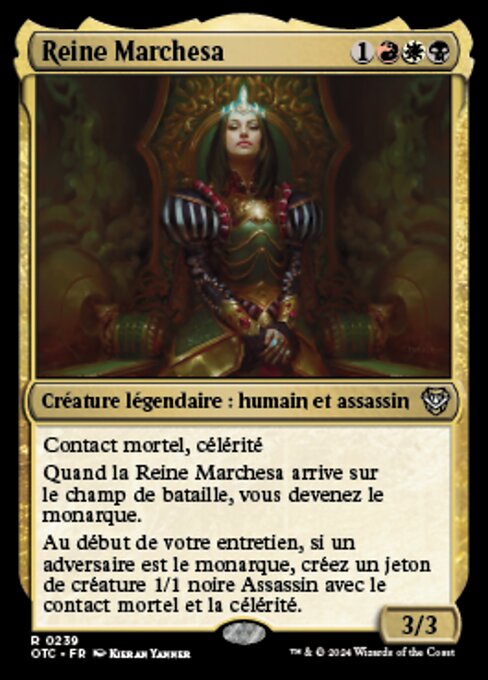
- Queen Marchesa — generates 1/1 Assassin tokens through the monarch mechanic.
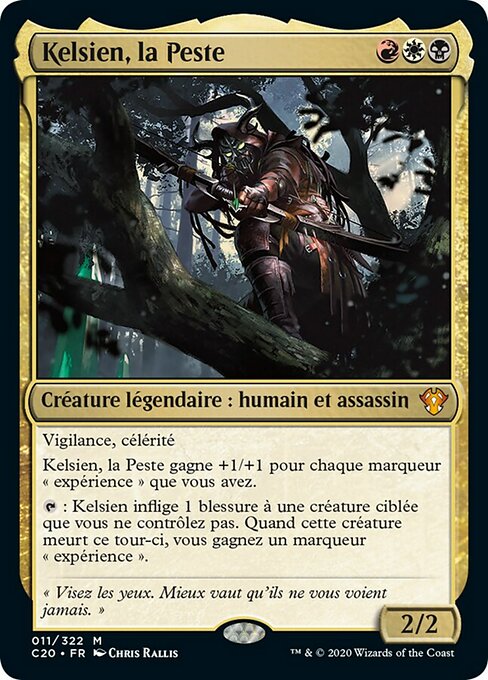
- Kelsien, the Plague — a Mardu commander geared toward control and "pinging," with strong deathtouch synergy.
- Achilles Davenport — a lord with menace, making it easier to trigger freerunning by forcing damage through.
| Commander | Key Mechanic | Role in the Deck |
|---|---|---|
| Ezio Auditore da Firenze | Freerunning + cost reduction | Finisher (alternative win) |
| Ramses, Assassin Lord | +1/+1 anthem for Assassins | Typal pressure + alternative win |
| Queen Marchesa | Monarch | 1/1 Assassin token generation |
| Kelsien, the Plague | "Pinging" + deathtouch | Control / removal (Mardu) |
| Achilles Davenport | Menace | Triggers freerunning more easily |
To place Assassins among the format's other tribal decks, the top 10 tribal Commander precons according to EDHREC offers useful reference points, as does our overview of a Wizards typal deck in Commander.
Freerunning, Key Cards, and Win Conditions
The mechanic that powers the archetype is freerunning, an alternative cost introduced by Assassin's Creed.
You may cast a card for its freerunning cost if, this turn, you dealt combat damage to a player with an Assassin or with your commander. The creature in question doesn't even need to still be alive by the time you pay that cost.
Wizards of the Coast, Assassin's Creed Mechanics (2024)
In practice, a single hit opens the door to a flurry of discounted spells in the same turn. Hence the value of commanders like Ezio (cost reduction) or Achilles Davenport (menace): they secure the damage that "lights up" the rest of your hand.
On the key-cards side, Royal Assassin remains an excellent control tool, able to neutralize a tapped creature every turn. Win conditions, for their part, are split between pure combat — an opponent at a low total becomes an ideal target for Ezio — and the alternative wins carried by cards like Ramses, Assassin Lord.
A word of honesty, finally: Assassins remain a casual table typal, designed for friendly games, not a cutting-edge cEDH archetype. That's as much an asset as a limitation — the archetype is accessible and thematic without claiming to dominate a competitive meta.
Protecting and Storing Your Commander Deck: Sleeves and Deck Box
A Commander deck is played in singleton and contains exactly 100 cards, commander included. The constraint comes at just the right moment: a pack of 100 Dragon Shield sleeves in standard size (66 × 91 mm, for Magic cards of roughly 63 × 88 mm) protects an entire deck in single-sleeve, with no needless surplus.
Players after a premium look and maximum durability move to double-sleeving: in that case you need to budget for two packs of 100 per deck. To choose thickness and finish well, our sleeves guide details all the options.

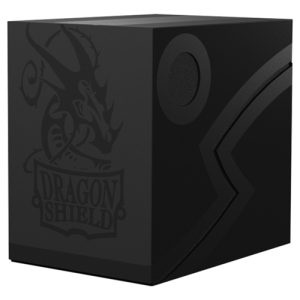
That leaves transport. Once sleeved, a 100-card deck takes up space: better to use a deck box designed for that capacity, ideally double-sleeve compatible. The storage and transport guide runs through the formats; for a single well-protected deck, a rigid shell like the Dragon Shield Double Shell ticks the boxes.
Key Takeaways
Thirty years after Royal Assassin, Assassins finally have what they need to form a real typal deck, thanks to Assassin's Creed and freerunning. Ezio, Ramses, and Queen Marchesa each offer a different point of entry — between control, aggro, and table politics. All that's left is to assemble your 100 cards, then protect them as they deserve. Which Assassin commander would you pick to kick things off at your game table?
Sources: EDHREC – Guide to Assassins in Commander, Wizards of the Coast – Assassin's Creed Mechanics, EDHREC – Ezio Auditore da Firenze, Scryfall – Royal Assassin (Alpha), Dragon Shield