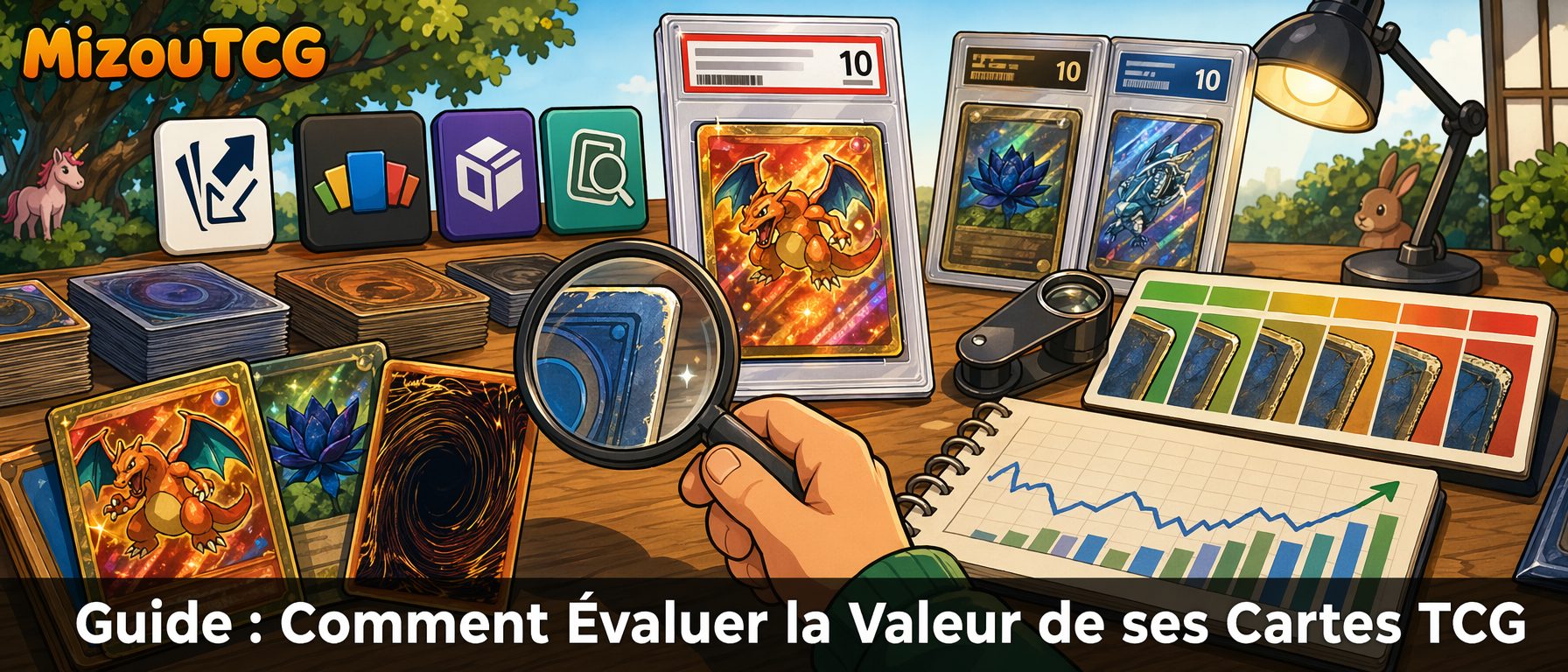
Did you find an old card collection in a closet? Are you wondering whether your childhood Pokémon cards are worth anything? Or do you simply want to know the value of your current collection?
This guide explains how to properly evaluate the value of your TCG cards, whether for Magic: The Gathering, Pokémon, Yu-Gi-Oh!, or any other collectible card game.
Factors that influence a card's value
A card's value depends on several criteria. Understanding these factors will help you better evaluate your collection.
Rarity
The rarer a card is, the more valuable it tends to be. Rarity indicators vary by game:
- Magic: Expansion symbol (black = common, silver = uncommon, gold = rare, orange = mythic)
- Pokémon: Symbol at the bottom (circle = common, diamond = uncommon, star = rare, + variants)
- Yu-Gi-Oh!: Markings on the card (Common, Rare, Super Rare, Ultra Rare, Secret Rare, etc.)
Card condition (grading)
Condition is crucial. A Near Mint card can be worth 2 to 10 times more than the same card in Played condition.
Condition scale (best to worst):
| Abbreviation | Condition | Description |
|---|---|---|
| M / MT | Mint | Perfect, as if just pulled from the booster |
| NM | Near Mint | Nearly perfect, micro-imperfections invisible |
| LP / EX | Lightly Played / Excellent | Slight visible wear (corners, edges) |
| MP / GD | Moderately Played / Good | Obvious wear but card intact |
| HP / PL | Heavily Played / Played | Heavy wear, creases, scratches |
| DMG | Damaged | Major damage (tears, stains, etc.) |
Demand (playability and collectibility)
A card heavily played in tournaments will have high demand and therefore a high price. A rare but unplayable card may be worth less than an uncommon one that sees a lot of play.
For pure collecting, nostalgic, iconic, or artistically remarkable cards also have strong demand.
Edition and print run
The original edition can be identified by the expansion symbol printed on each card: for example, a Tarkir Dragonstorm Booster - French - Magic The Gathering (4,60€) makes it possible to precisely identify the Tarkir set, whereas a Booster Innistrad Remastered - French - Magic The Gathering (4,35€) gathers cards from the Innistrad Remastered set with their own markers.
The first edition of a card is often worth more than reprints. For Pokémon, "1st Edition" or "Shadowless" cards from the first series can be worth thousands of dollars.
For Magic, Alpha/Beta cards (1993) are the most sought after.
Special versions
Some versions of the same card are worth much more:
- Foil/Holo: Shiny versions
- Full Art: Illustration extended across the entire card
- Extended Art: Reduced borders
- Borderless: No border
- Serialized: Numbered (e.g., 042/500)
- Promo: Distributed at special events
Tools to find a card's price
Several platforms allow you to check the market value of your cards.
Cardmarket (Europe)
THE reference in Europe for TCG card prices. Cardmarket is a marketplace where thousands of sellers list their cards.
How to use it:
- Search for your card by name
- Select the correct edition and version (foil, regular...)
- Check the "Price Trend" (average of recent sales)
- Look at current offers for the matching condition
Tip: The "Price Trend" is more reliable than the lowest price displayed.
TCGPlayer (United States)
The American equivalent of Cardmarket. Useful for American cards or to compare markets. Prices are in dollars.
Scanning apps
These apps scan your cards and instantly display their value:
- Manabox (Magic): Quick scan, integrated Cardmarket prices
- TCGPlayer App: Multi-TCG, American prices
- Collectr: Multi-TCG, good scanner
Limitation: Scans don't detect card condition. Adjust manually based on visible wear.
To compare opened vs. sealed values, scan for example the contents of a Booster Collector Marvel's Spider-Man - French - Magic The Gathering (28,00€) and compare the Cardmarket total against the purchase price: a good test for understanding the profitability of a Collector Booster.
How to evaluate the condition of your cards
Self-evaluation is a difficult exercise. Here's how to proceed methodically.
Required equipment
- Good lighting: Natural light or a powerful lamp
- Magnifier (optional): For micro-defects
- Clean surface: For handling cards
- Clean, dry hands
Points to check
- Corners: Wear, whitening, creases?
- Edges: Scratches, whitening (white wear)?
- Surface: Scratches, fingerprints, dirt?
- Card back: Often overlooked but just as important
- Centering: Are the borders equal on all 4 sides?
- Creases: Hold the card up to the light to detect folds
Be honest (and conservative)
The golden rule: when in doubt, choose the lower condition. If you're hesitating between NM and LP, it's probably LP. Buyers and grading services are strict.
Professional grading
For high-value cards, professional grading can be worthwhile. An expert evaluates your card and encapsulates it with an official grade.
The main grading companies
| Company | Specialty | Reputation |
|---|---|---|
| PSA | Multi-TCG, especially Pokémon | Most recognized, high prices |
| BGS (Beckett) | Multi-TCG, detailed grades | Highly respected, sub-grades by criterion |
| CGC | Multi-TCG | Rising alternative, good value for money |
The grading scale
Grades generally range from 1 to 10:
- 10 (Gem Mint): Absolute perfection
- 9 (Mint): Nearly perfect
- 8 (NM-MT): Excellent
- 7 (NM): Very good
- 6 and below: Visible wear
When should you grade a card?
Grading costs between $20 and $150+ per card depending on the service and turnaround time. It's worthwhile if:
- The card is worth >$100 ungraded
- You expect to get a grade of 9 or 10
- You plan to sell or insure the card
A PSA 10 card can be worth 2 to 10 times more than the same ungraded card.
Method for evaluating an entire collection
Evaluating a collection of hundreds or thousands of cards requires a methodical approach.
Step 1: Sort by potential value
Quickly separate:
- Potentially expensive cards: Rares, mythics, holos, promos, old cards
- Bulk: Recent commons and uncommons
Step 2: Scan the valuable cards
Use an app like Manabox or Collectr to scan your sorted cards. Create an inventory.
Step 3: Evaluate the condition of expensive cards
For each valuable card (>$5), evaluate the condition manually and adjust the price accordingly.
Step 4: Estimate the bulk
Bulk (common cards) generally sells for $0.50 to $3 per 100 cards depending on the game and condition. Don't waste time evaluating each common individually.
Step 5: Calculate total value
Add up:
- Value of individual cards (after condition adjustment)
- Estimated bulk value
- Apply a 10-20% discount if you plan to sell (buyer's margin)
Pitfalls to avoid when evaluating
Overestimating your cards' condition
This is the most common mistake. We tend to be too optimistic about our own cards. Be critical and objective.
Confusing editions
A card can exist in dozens of versions. A recent reprint is often worth much less than the original. Check the expansion symbol and number.
Trusting "asking" prices
On Cardmarket or eBay, look at completed sales, not asking prices. Someone can list a card for $1,000—that doesn't mean it will sell.
Ignoring selling fees
If you plan to sell, don't forget platform commissions (5-15%) and shipping costs.
The "it's an old card so it must be expensive" myth
False! Age alone doesn't make value. A common from 1995 may be worth $0.10 if no one wants it. Demand outweighs age.
FAQ – Frequently Asked Questions
Are my Pokémon cards from 1999 worth a lot?
It depends. Base set 1st Edition cards in good condition can be worth hundreds or even thousands of dollars (Charizard especially). But most common cards from that era are worth less than $1. Check each card individually.
How do I know if my card is a first edition?
For Pokémon: Look for the "1st Edition" symbol (black stamp) or the absence of a shadow under the illustration (Shadowless). For Magic: Alpha/Beta cards have more rounded corners and no copyright date.
Does a creased card still have value?
Yes, but reduced. A major crease can drop the value by 50-80%. For very rare cards, even a damaged version can be worth something. For common cards, a creased version is generally unsellable.
Should I grade all my cards?
No. Grading is only worthwhile for high-value cards (>$100) in excellent condition. Grading a $5 card will cost you more than the card itself.
Is the Cardmarket price reliable?
It's the best reference for Europe. The "Price Trend" reflects recent sales. Be careful: prices can change quickly for tournament-played cards (meta-dependent).
How do I sell my cards for the best price?
For valuable cards: Cardmarket (Europe) or direct sale to collectors. For bulk: lot sales on local marketplaces or to shops (buyback at ~50% of the price).
Conclusion
Properly evaluating your cards requires:
- Identifying the exact card (edition, version, language)
- Honestly evaluating its condition
- Checking prices on Cardmarket or TCGPlayer
- Adjusting based on actual condition
For high-value cards, professional grading can multiply the price. For the rest, an honest evaluation and clear photos will be enough to sell at a fair price.
Happy evaluating your collection!
Want to test your eye on fresh cards? Open a Booster Collector Lorwyn Eclipsed - English - Magic The Gathering (30,00€) and apply the evaluation grid above to each rare or mythic card.
Products recommandés