- The Splendor of the Thran Empire
- Halcyon: The Suspended City
- The Two Geniuses: Glacian and Rebbec
- Glacian — The Father of Powerstones
- Rebbec — The Visionary Architect
- The Shadows of the Empire
- The Eumidians: An Enslaved Race
- The Council of Halcyon
- The Return of Yawgmoth
- Yawgmoth's "Healing"
- The Discovery of Phyrexia
- The Civil War
- The Two Camps
- The Fall of Halcyon
- Rebbec's Final Act
- The Legacy of the Thran
- In the next episode...
- Sources
Millennia after the War of the Elder Dragons, as the scars of the conflict faded beneath forests and oceans, a human civilization reached heights the Multiverse had never known. Their cities floated in the air. Their machines defied the laws of nature. Their scholars unlocked the secrets of mana itself.
They called themselves the Thran. And their fall would be as spectacular as their rise.
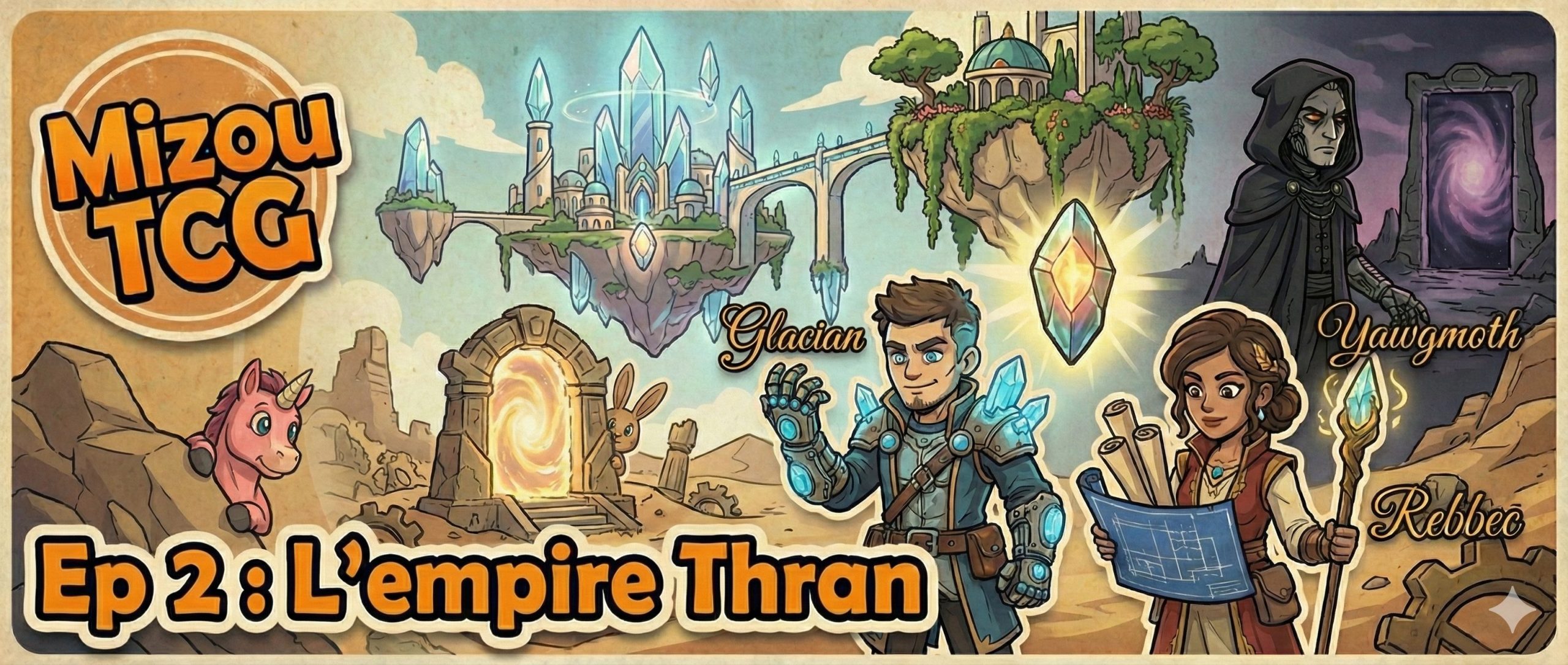
In the previous episode, we explored the War of the Elder Dragons and the origins of the conflict between Nicol Bolas and Ugin. Today, we leap forward by millennia to discover the characters who lived through the Thran tragedy from within: the brilliant artificer Glacian, the visionary architect Rebbec, and the political forces that allowed an exiled physician to destroy the greatest civilization Dominaria had ever known.
The Splendor of the Thran Empire
At its peak, the Thran Empire dominated an entire continent of Dominaria. Eight city-states formed its political structure: Halcyon, the floating capital; Nyoron, the industrial center; Seaton, the maritime port; Phoenon, Orleason, Chignon, Losanon, and Wington.
But it was Halcyon that embodied the glory of the Thran.
Halcyon: The Suspended City
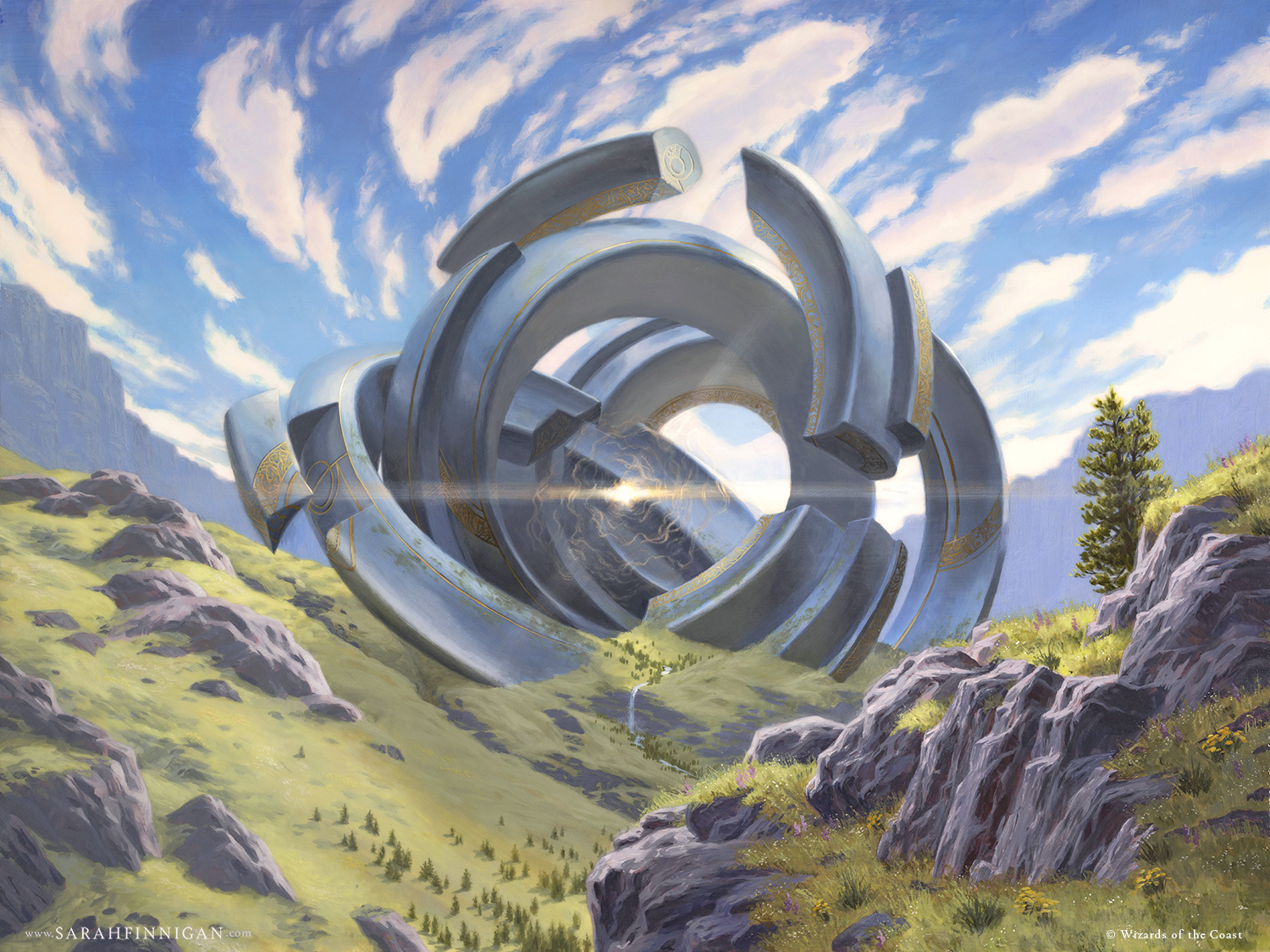
Halcyon did not rest on the ground. It floated above the Caves of Koilos, held aloft by force fields powered by countless Powerstones. Crystal towers rose toward the clouds, connected by bridges of solidified light. Hanging gardens overflowed with exotic flowers. Artificial waterfalls cascaded into the void, their water collected and recycled by ingenious systems.
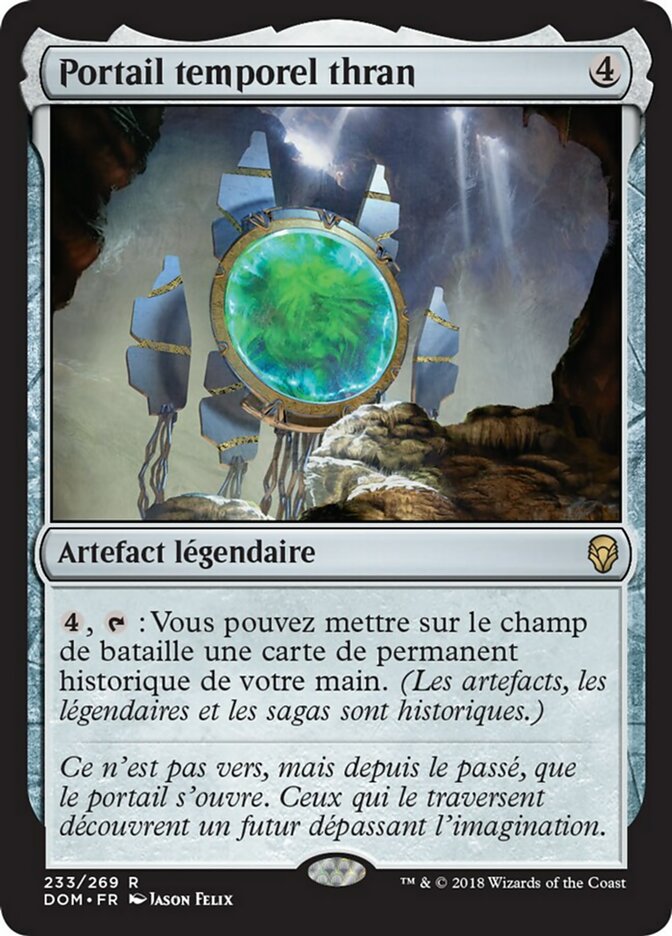
Thran technology surpassed anything Dominaria would know for millennia. Their portals allowed travelers to cross the empire in an instant. Their golems performed laborious tasks. Their flying vehicles traversed the skies. And at the heart of it all: the Powerstones, crystals capable of storing phenomenal quantities of mana.
But this technological marvel hid a fatal flaw.
The Two Geniuses: Glacian and Rebbec
At the pinnacle of Thran society, two figures dominated the intellectual landscape: Glacian, the empire's greatest artificer, and Rebbec, his wife, architect of Halcyon's wonders.
Glacian — The Father of Powerstones
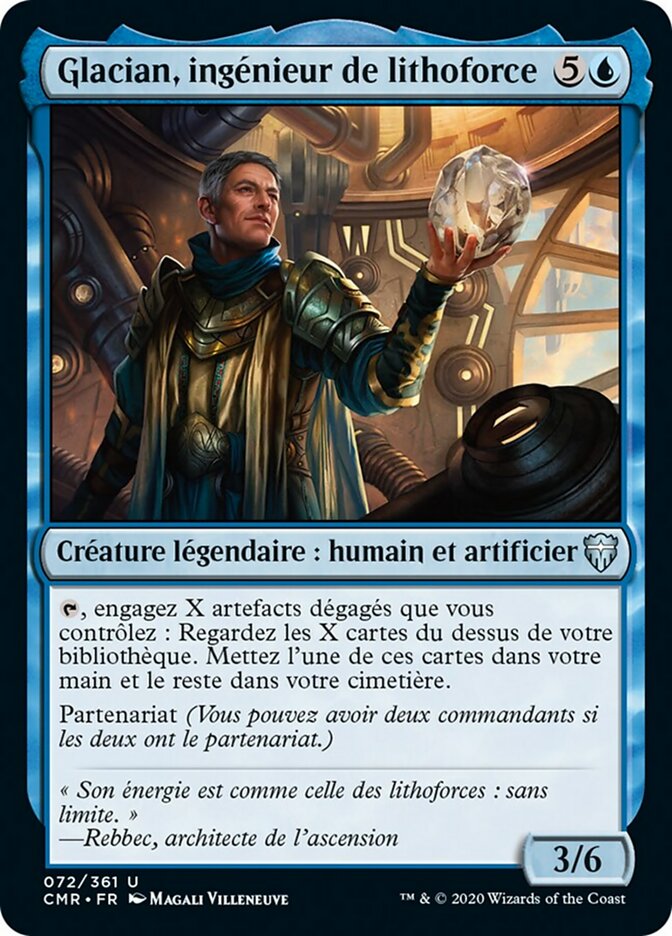
Glacian was a genius. Not just intelligent — visionary. Where other artificers were content to use existing Powerstones, Glacian sought to understand their deeper nature, to improve them, to push the boundaries of the possible.
His innovations had transformed the empire. Next-generation Powerstones were more stable, more durable, more powerful. Halcyon itself only floated thanks to Glacian's improvements. He was adored by the people, respected by his peers, and feared by his rivals.
But Glacian had a fatal flaw: his obsession. He spent entire days in his laboratories, neglecting his health, his family, anything that wasn't his research. He handled Powerstones with his bare hands, exposing himself to their radiation without protection.
And one day, he began to cough.
Rebbec — The Visionary Architect
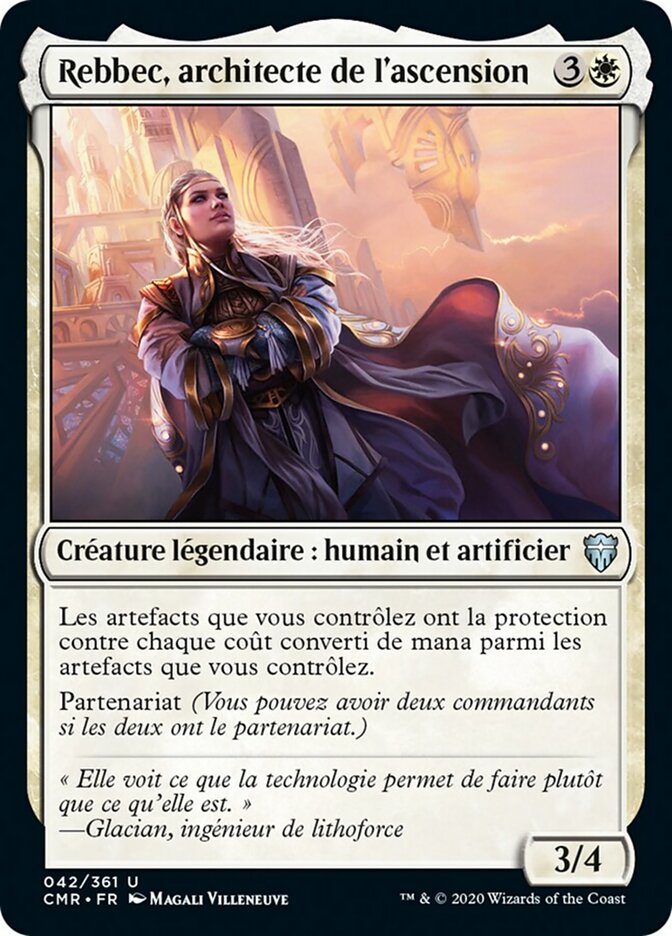
If Glacian was the empire's technical brain, Rebbec was its artistic soul. A brilliant architect, she had designed Halcyon's most iconic structures: the Council Palace, the Great Library, the Hanging Gardens.
Her style blended functionality with beauty. Every building she designed was both a marvel of engineering and a work of art. She understood that architecture wasn't just about walls and roofs — it was a way of giving form to the aspirations of a civilization.
Rebbec loved Glacian deeply, but their marriage was... complicated. She watched him sink deeper into his work, neglecting his health, and could do nothing to stop him. When the first symptoms of Phthisis appeared, she was devastated.
It was in this moment of vulnerability that a certain exiled physician returned to Halcyon.
The Shadows of the Empire
The grandeur of the Thran Empire rested on a shameful secret: the Eumidians.
The Eumidians: An Enslaved Race
The Eumidians were a humanoid race the Thran considered inferior. They had no right to citizenship, could not own land, and could not testify against a Thran in court. They performed the most dangerous work — particularly in the Powerstone mines.

This exploitation had a predictable consequence: the Eumidians developed Phthisis at alarming rates. But as long as the disease remained confined to the lower classes, the Thran elite turned a blind eye.
Until Glacian, the empire's greatest artificer, began to show the same symptoms.
Suddenly, Phthisis was no longer a Eumidian problem. It was a national crisis.
The Council of Halcyon
The Thran Empire was governed by a Council of nobles and scholars. In theory, they made decisions collectively. In practice, intrigue, alliances, and betrayals were commonplace.
When Phthisis began striking the elite, the Council split. Some wanted to close the Powerstone mines. Others refused to sacrifice the empire's prosperity for a disease they would surely cure eventually. Still others sought a scapegoat.
It was then that a name resurfaced from the archives: Yawgmoth. A brilliant physician, exiled years earlier for experiments deemed unethical. But a physician who had studied Phthisis like no one else.
The Council voted to recall him. Rebbec opposed the decision — she had heard troubling rumors about his methods. But Glacian, desperate, pleaded in his favor.
That vote would seal the fate of the Thran Empire.
The Return of Yawgmoth
Yawgmoth returned to Halcyon as a hero. The exiled physician, recalled to save the empire. The story was too good not to be told.
He took up his post at Glacian's bedside, studying his disease with an intensity that impressed everyone. He made crucial discoveries: Phthisis was caused by Powerstone radiation. The Thran were poisoning themselves with their own technology.
But his "cure" was something else entirely.
Yawgmoth's "Healing"
Yawgmoth proposed a radical solution: replace diseased organs with mechanical prostheses. Artificial lungs. Hearts of metal. Limbs of chrome and steel.
The first patients survived. They were no longer truly human, but they lived. For a desperate society, that was enough.
But Rebbec watched in horror. She saw what others refused to see: Yawgmoth wasn't trying to heal. He was trying to transform. Every patient was an experiment, every "cure" a step toward something greater — and far more terrible.
She tried to warn the Council. No one listened. Yawgmoth had become too popular, too powerful. And Glacian, her own husband, was now under the physician's care.
The Discovery of Phyrexia
Yawgmoth had a secret. A planeswalker named Dyfed, fascinated by his intellect, had revealed to him the existence of other planes — other worlds beyond Dominaria. She had taken him to visit the Multiverse.
And she had shown him an abandoned plane. An artificial world made of nine concentric spheres, like the circles of Hell. An empty place, waiting to be filled.
Yawgmoth named it Phyrexia.
He began bringing his "cured" patients there. On this plane, far from the Council's eyes, he could push his experiments further. Much further.

The Civil War
The truth eventually came out. Survivors of Yawgmoth's experiments escaped from Phyrexia and recounted what they had seen: half-flesh half-machine horrors, tortures in the name of "perfection," a physician driven mad by power.
The Thran Empire tore itself apart.
The Two Camps
On one side, Yawgmoth's supporters. They were many — all those who owed him their lives, all those who believed in his vision of a world without disease, without weakness, without death. They included a significant portion of the army and several Council members.
On the other side, those who saw Yawgmoth for what he truly was. At their head: Rebbec.
Glacian, dying of Phthisis but refusing Yawgmoth's "care," created weapons to fight the physician's forces. War golems. Mana cannons. Shields capable of resisting Phyrexian creations.
But it was too late. Yawgmoth had had years to prepare his move.
The Fall of Halcyon
The war was brief but devastating. Yawgmoth's forces, reinforced by his Phyrexian creations, swept aside the resistance. Halcyon, the floating city, crashed to the ground when the Powerstones holding it aloft were destroyed in the fighting.
Millions died. The Thran Empire, which had ruled Dominaria for centuries, collapsed in a matter of weeks.
Yawgmoth fled to Phyrexia with his faithful and his creations, taking with him the secrets of Thran technology.
Rebbec's Final Act
In the ruins of Halcyon, Rebbec accomplished her most important act.
Glacian was dead — but not really. At the moment of his death, his latent planeswalker spark had awakened in a unique way: his soul had been absorbed by a Powerstone that Dyfed had cracked during his agony.
This Powerstone had broken into two halves: the Mightstone and the Weakstone.
Rebbec used these two stones to seal the portal to Phyrexia. She knew she could not destroy Yawgmoth — but she could imprison him in his own realm.
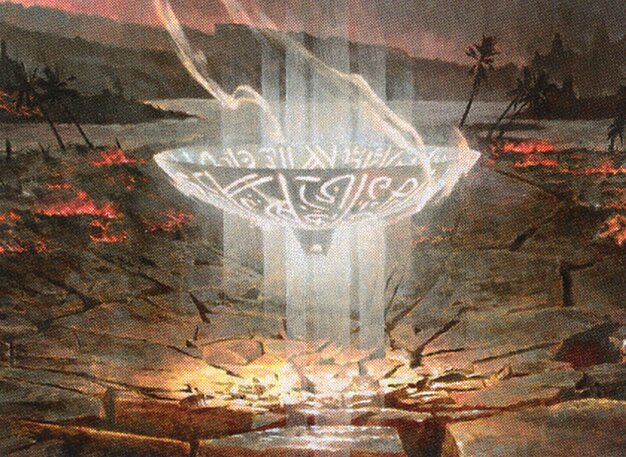
The seal would hold for millennia. But Rebbec knew nothing was eternal. One day, someone would find the stones. One day, the portal would reopen.
She was right.
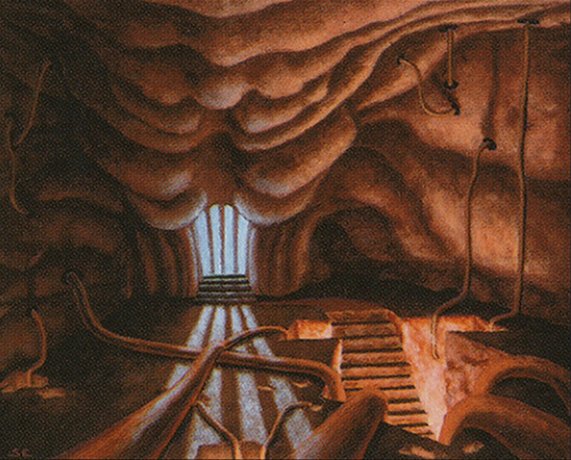
Millennia later, two brothers named Urza and Mishra would discover the ruins of Halcyon — a site legends would by then call the Caves of Koilos. They would find the Mightstone and the Weakstone. And the cycle would begin anew.
The Legacy of the Thran
The Thran Empire vanished, but its legacy endured.
Their artifacts still dot Dominaria. Powerstones are discovered regularly, fueling the research of modern artificers. The ruins of their cities draw archaeologists and tomb raiders alike.
Their technology influenced everything that followed. Urza, the greatest artificer in post-Thran history, spent his life trying to understand and reproduce their creations.
And their enemy — Yawgmoth, now the Father of Machines — waited patiently in the nine spheres of Phyrexia. Preparing his return. Perfecting his creations. Dreaming of the day when he would compleat the entire Multiverse.
The Thran had created a marvel. And in their arrogance, they had created absolute evil.
In the next episode...
Episode 0.3: The Birth of Phyrexia
Exiled from Dominaria, Yawgmoth transforms an empty plane into the biomechanical hell of Phyrexia. Discover how the Father of Machines created the nine spheres, developed the concept of Compleation, and spent millennia preparing his invasion of the Multiverse.
The black oil. The Praetors. The philosophy of mechanical perfection.
"All will be one."
Sources
- MTG Wiki: Thran Empire — Complete documentation on the empire and its structure
- MTG Wiki: The Thran (novel) — Summary of the novel by J. Robert King
- MTG Wiki: Glacian — Biography of the artificer
- MTG Wiki: Rebbec — Biography of the architect
- Commander Legends (Magic expansion, 2020) — Glacian and Rebbec cards