- A World in Recovery
- The Rise of Otaria
- The Discovery of the Mirari
- The Corrupting Power
- Kamahl, Champion of the Pits
- The Tragedy of Jeska
- Redemption Through Nature
- Phage: The Woman with the Deadly Touch
- Akroma: The Angel of Wrath
- The War of Incarnations
- Karona: The False God
- The Incarnation of Magic
- The Death of a Goddess
- Karn and the Creation of Argentum
- A World of Perfect Metal
- The Seeds of Corruption
- The Rifts: The Wounds of Time
- The Cosmic Consequences
- The Return of Teferi
- Summary: The Seeds of Catastrophe
- In the next episode...
- Sources
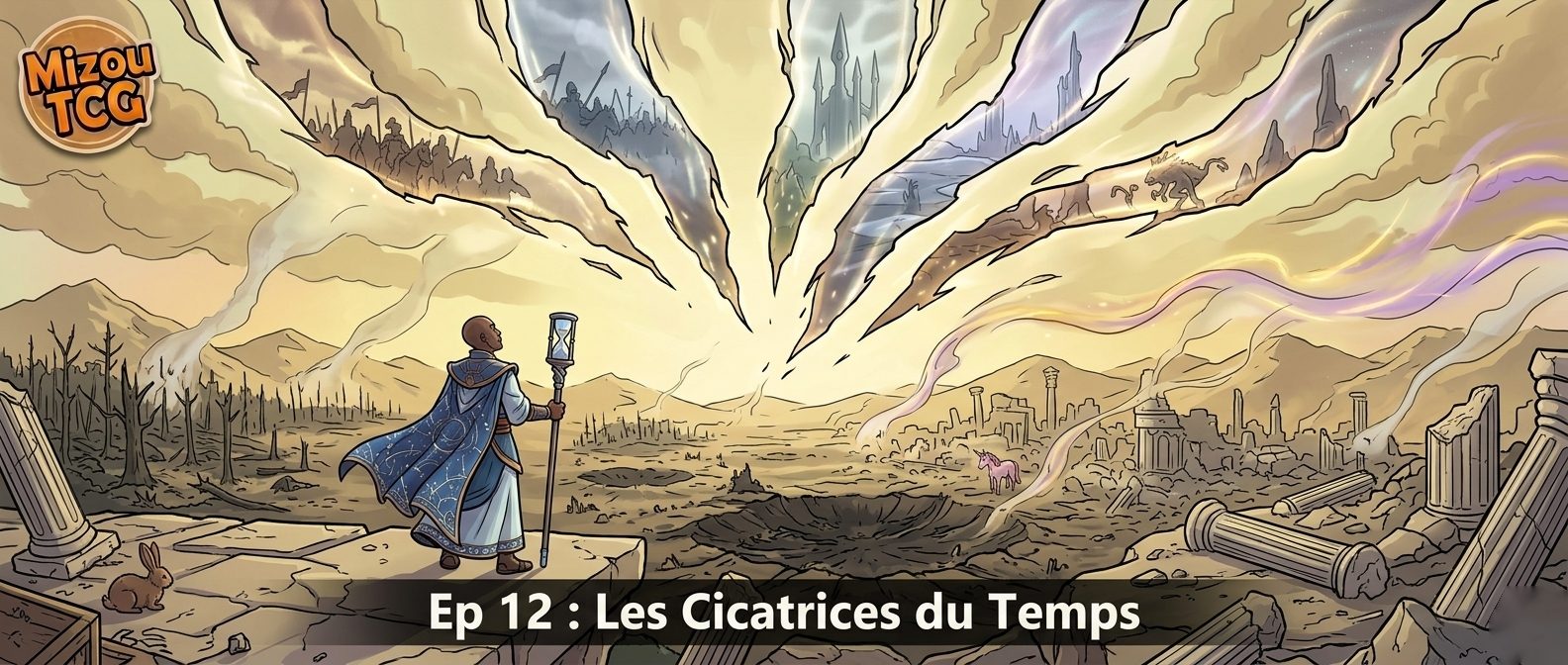
The sun rose over Otaria, but its light seemed pale, weakened. A century had passed since the destruction of Yawgmoth, and yet Dominaria still bore the scars of the Apocalypse. Entire continents remained dead lands, millennia-old forests were now nothing but ashes, and the sky itself seemed sick — sometimes crossed by strange glimmers, tears in the fabric of reality.
Welcome to episode 6 of our exploration of Magic: The Gathering lore. We are entering a new era: the Era of Rifts. After the pyrrhic victory against Phyrexia, the Multiverse must face the consequences of four thousand years of conflict — cosmic wounds that threaten to engulf reality itself.
A World in Recovery
The destruction of Yawgmoth had saved Dominaria, but at what cost? Entire nations had been wiped off the map. Benalia, Llanowar, Urborg — all bore the scars of the Phyrexian invasion. The world's population had been decimated. Magic itself seemed weakened, as if the entire plane suffered from an invisible disease.
But life, as always, found a way. New civilizations emerged from the ruins. New heroes rose to fill the void left by the old ones. And at the center of this rebirth, a continent long considered peripheral was taking on new importance: Otaria.
The Rise of Otaria
Otaria was a wild continent, far from Dominaria's ancient great powers. During the Phyrexian invasion, its isolation had relatively spared it. Now, while the ancient capitals lay in ruins, Otaria was becoming the new beating heart of the world.
Three main factions vied for control of the continent:
- The Cabal — A criminal organization led by the mysterious Patriarch, specializing in gladiatorial combat and dark magic
- The Order — The spiritual heirs of Benalia, knights seeking to impose their vision of justice
- The Pardic Barbarians — Fierce warriors living in the volcanic mountains, faithful to ancient traditions
These factions coexisted in a fragile peace, their conflicts channeled into the Cabal's combat arenas — pits where warriors fought for glory, gold, and sometimes far more precious prizes...
The Discovery of the Mirari
It was in this context that the artifact which would upend Otaria's fate appeared: the Mirari. A perfect sphere of silver metal, pulsing with mysterious energy. No one knew where it came from or who had created it.
What the inhabitants of Otaria did not know was that the Mirari was the work of Karn. The golem who had become a planeswalker had created this probe to explore the Multiverse and gather information. But something had gone wrong. The Mirari had developed unforeseen properties — it amplified the desires of whoever touched it, making them real... often with catastrophic consequences.
The Corrupting Power
The Mirari passed from hand to hand, leaving behind a trail of destruction. Each bearer was consumed by their own desires amplified to the point of madness. A mage wanted absolute knowledge — he became a shapeless mass of pure consciousness, unable to think coherently. A general wanted victory — his armies multiplied until they devoured each other for lack of resources.
The artifact was recovered by Chainer, a Cabal dementist capable of bringing nightmares to life. Fascinated by its power, he offered it to the Patriarch, who decided to use it as the ultimate prize in arena tournaments. Warriors from around the world flocked to Otaria, ready to do anything to seize this wonder.
On the left, Chainer, the Dementia Master, whose nightmarish powers made him one of the Patriarch's most valuable servants. In the center, the Cabal Coffers, symbol of the wealth and power accumulated by the organization in the swamps of Otaria. On the right, a Nantuko Shade, one of many corrupted creatures that served the Cabal's interests.
Kamahl, Champion of the Pits
Among the fighters flocking to the arenas, a barbarian from the Pardic Mountains stood out for his ferocity and ambition: Kamahl. Armed with a legendary two-handed sword and wielding fire magic, he racked up victories with disconcerting ease.
Kamahl did not fight for gold or glory. Ever since he had glimpsed the Mirari shining atop the Patriarch's throne, a consuming obsession had taken hold of him. He had to possess that sphere. Every night, he dreamed of its silver gleam. Every day, he killed to get closer to it.
The Tragedy of Jeska
Kamahl had a sister, Jeska, a warrior as fearsome as he was. Together, they had grown up in the mountains, training in combat from a young age. Their bond was deep — two souls forged in the same fire.
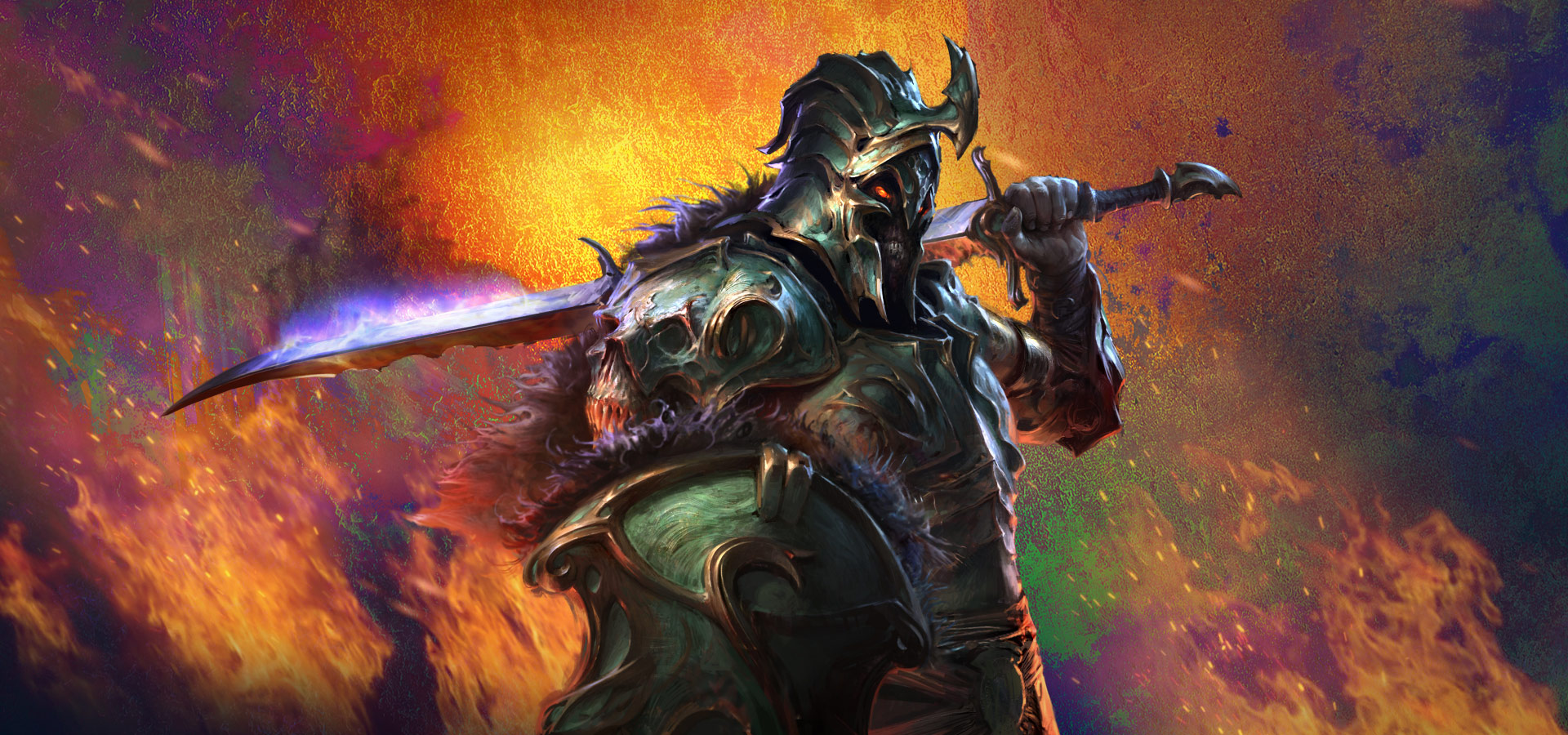
When Kamahl finally won the Mirari after a series of bloody battles, he made his first mistake: he affixed the artifact to the pommel of his sword. The Mirari's energy mingled with his fire magic, amplifying his power... and his rage.
Returning to the Pardic Mountains, Kamahl tried to unify the barbarian tribes under his command. But his amplified ambition made him tyrannical, ruthless. When Jeska dared to challenge him, questioning his thirst for power...
In a fit of uncontrollable rage, Kamahl struck.
His own sister. With the Mirari Sword.
The blade left a wound impossible to heal — a magical burn that slowly consumed Jeska from within. No magic, no healer could close that wound. She was condemned to a slow and agonizing death.
"I saw the light of the Mirari, and it revealed the monster I had become." — Kamahl, after wounding Jeska
Redemption Through Nature
Horrified by his act, Kamahl desperately searched for a way to save his sister. His search led him to Krosa, an ancient and wild forest where nature itself seemed conscious. There, an ancient nantuko druid named Thriss agreed to teach him.
Kamahl's journey was long and painful. He had to abandon the rage that had defined him all his life, learn to listen rather than dominate, to protect rather than destroy. The forest's green magic gradually replaced the red flames of his youth.
On the left, Kamahl, Fist of Krosa — the barbarian transformed into a protector of the forest, his rage channeled into the defense of nature. In the center, a Krosan Beast, one of the mutant creatures born from the Mirari's influence on the forest. On the right, Silvos, a wild elemental allied with Kamahl in his quest for redemption.
While Kamahl was being transformed, Jeska was succumbing to her wound in a way no one had foreseen. The Mirari's corrupted magic was not killing her — it was transforming her.
Phage: The Woman with the Deadly Touch
Jeska died... and was reborn under the name Phage. Her body had survived, but her soul had been twisted by dark magic. From now on, everything she touched died instantly. A simple touch of her bare skin was enough to rot flesh, dissolve metal, extinguish life.
The Cabal, always on the lookout for new champions, hastened to recruit this nightmare creature. In the arenas, Phage was invincible — no opponent could touch her without perishing. She became the most feared champion of Otaria, a living legend of death and destruction.
But somewhere, deep within that corrupted body, a spark of Jeska survived. Fragments of memory, flashes of consciousness — the woman she had been struggled against the monster she had become.
Akroma: The Angel of Wrath
While Phage spread death in the arenas, another extraordinary being was coming into existence. Ixidor, a brilliant illusionist, had lost his beloved wife Nivea in a fight against Phage. Mad with grief, he exiled himself in the deserts of Otaria.
There, isolated from the world, Ixidor discovered a terrifying power: his illusions became real. Everything he imagined took form, substance, life. And in his sorrow, he imagined an angel — a being of pure light, forged to avenge Nivea.
On the left, Ixidor, Reality Sculptor, the illusionist whose power transcended the limits of imagination. In the center, Akroma, Angel of Wrath, his most perfect creation — a being of pure vengeance against Phage. On the right, Akroma's Memorial, testament to the impact she would have on the history of Otaria.
Akroma was magnificent and terrifying. Her wings of light set the sky ablaze. Her spear pierced everything in its path. And her sole objective, implanted in her very essence by Ixidor, was to destroy Phage.
But Akroma was not really an angel. She was an illusion made flesh, a fantasy of vengeance with no soul of her own. She had the form of purity, but her heart harbored only her creator's hatred.
The War of Incarnations
The conflict between Phage and Akroma tore Otaria apart. The Angel gathered an army of the faithful who saw her as a divine messenger. Phage commanded the forces of the Cabal, her legions of undead and nightmare creatures. Two armies, two philosophies, two incarnations of opposite extremes.
The battles claimed thousands of lives. Entire cities were razed. The continent, already weakened by the aftermath of the Phyrexian invasion, was sinking into total chaos.
And in the midst of this carnage, Kamahl watched. The druid he had become now understood what the barbarian had never seen: the Mirari was the source of all this evil. As long as the artifact existed, the destruction would continue.
Karona: The False God
Otaria's fate turned on an apocalyptic battle. Kamahl, seeking to end the conflict, faced both Phage and Akroma simultaneously with a special weapon: the Soul Reaper Blade, forged to sever magical essences.
When the blade struck, something unthinkable happened. Phage, Akroma, and a third woman present on the battlefield — Zagorka, an old warrior — were all three killed simultaneously. But their essences, instead of dissipating, merged in an explosion of pure magic.
From this fusion emerged Karona.
The Incarnation of Magic
Karona was not merely powerful — she was magic incarnate. All the mana of Dominaria flowed through her. Her presence altered reality around her. And most dangerous of all: she could accomplish anything that people believed she could do.
The inhabitants of Otaria took her for a goddess. Armies of the faithful prostrated themselves before her. And the more they believed in her, the more her powers grew. Karona destroyed cities with a gesture. She killed the Numena — ancient sorcerer-kings who had survived since the dawn of Dominaria — with a single spell.
But Karona was unstable. Three consciousnesses fought within her: Phage's rage, Akroma's vengeance, Zagorka's fragmented memories. She was a cosmic time bomb.
The Death of a Goddess
Karona's end came unexpectedly. Two loyal servants — Sash and Waistcoat, creatures created by Ixidor — struck her with the Mirari Sword while she was attacking Kamahl. The artifact that had caused so much suffering was the instrument of her destruction.
When Karona died, she decomposed into her three original components. Akroma and Zagorka perished for good. But Jeska... Jeska returned. Not only healed of her corruption, but transformed in a fundamental way. The energy released by Karona's death had awakened something within her.
A spark.
Jeska, Kamahl's sister, had become a planeswalker.
Karn and the Creation of Argentum
While chaos consumed Otaria, Karn traveled the Multiverse. The golem had become one of the most powerful beings in existence — bearer of Urza's spark, of four millennia of wisdom, and of a burden of guilt for all the sacrifices he had witnessed.
Karn dreamed of creating something pure. After witnessing so much destruction — the Brothers' War, the Phyrexian invasion, the Apocalypse — he wanted to prove that creation could triumph over destruction.
He found a desolate space between the planes, a pocket of void he could shape according to his will. And there, alone, he created Argentum.
A World of Perfect Metal
Argentum was a wonder. A world made entirely of metal — silver, gold, chrome — where every structure followed perfect geometric patterns. No war. No suffering. No death. Just the pure beauty of creation.
But Karn could not stay forever to watch over his creation. The Multiverse was vast, and he had other responsibilities. He needed a guardian.
He remembered the Mirari — the probe he had created and that had caused so much damage on Otaria. Karn recovered the artifact and transformed it. He gave it a humanoid form, a consciousness, a purpose. The Mirari became Memnarch.
The Seeds of Corruption
Karn was unaware that he carried within him a deadly passenger. During his travels through Phyrexia with the Nine Titans, during the years aboard the Weatherlight, traces of Phyrexian oil had accumulated in his mechanisms. Just a few drops, invisible, seemingly harmless.
But Phyrexian oil is never harmless. It waits. It spreads. It corrupts.
When Karn created Memnarch and entrusted Argentum to him, he left traces of this oil in the palace he had built for his guardian. And the oil began its patient work.
Memnarch, over the centuries, changed. His loyalty to Karn turned into obsession. His mission of protection became a quest for power. He wanted a planeswalker spark for himself. And to obtain it, he was ready for anything.
He renamed Argentum to Mirrodin. He used soul traps to kidnap creatures from other planes and study them. He turned the metal paradise into a giant laboratory, searching for the secret of the spark in the flesh of his prisoners.
And all this time, the Phyrexian oil was spreading into every corner of the plane...
The Rifts: The Wounds of Time
While Mirrodin was slowly sinking into corruption, another problem — far more serious — threatened the entire Multiverse. The Time Rifts were becoming visible.
These tears in the fabric of reality had existed for a long time, but they had remained hidden, dormant. Now, after the Apocalypse, after Karona's death, after millennia of abuses of power by quasi-divine planeswalkers, they were opening.
Each rift had been born of a cataclysm:
- Tolaria — Urza's temporal experiments had created a wound that had never closed
- Yavimaya — The explosion of the Sylex, millennia earlier, had torn time apart
- Shiv and Zhalfir — Teferi had phased them out of reality during the invasion, creating anomalies
- Urborg — The Rathi Overlay had left dimensional scars
- Otaria — Karona's death had opened the most recent wound
- Madara — A battle between Nicol Bolas and a leviathan demon, fifteen thousand years earlier
On the left, the Riftsweeper, one of the rare creatures capable of perceiving temporal anomalies. In the center, Temporal Isolation represents the fate of those trapped outside their time. On the right, Reality Acid illustrates how the very structure of existence was dissolving around the rifts.
The Cosmic Consequences
The rifts were not merely visual curiosities. They drained the mana of Dominaria — and by extension, of the entire Multiverse. With each passing day, magic weakened. Spells became more difficult to cast. Magical creatures died for no apparent reason.
More worrying still, the rifts let things through. Echoes from the past and the future seeped into the present. Armies from bygone eras marched again. Creatures that did not yet exist appeared and disappeared. Time itself was becoming unstable.
Planeswalkers who approached the rifts felt intense pain, a fundamental dissonance with their very nature. Something had to be done — but what? How do you repair wounds in the fabric of reality?
The Return of Teferi
Teferi had been absent during the Phyrexian invasion. The former student of Tolaria, having become one of the most powerful planeswalkers in the Multiverse, had chosen to phase Shiv and Zhalfir out of reality rather than see them destroyed by Phyrexia.
At the time, this had seemed the wise decision. Now, centuries later, Teferi understood his mistake. His act of "protection" had created two of the most dangerous rifts. And Zhalfir — his homeland, his people — was still trapped in the void, unable to return.
Teferi returned to Dominaria to assess the extent of the damage. The plane he had known was unrecognizable. Entire continents were dead lands. Magic was fading. And above it all, the gaping rifts tore the sky.
He understood that he could not repair what he had helped break alone. He would need help — and sacrifices that even he hesitated to contemplate.
On the left, Teferi, Temporal Pilgrim, marked by centuries of travels through time and space. In the center, Disrupt Decorum illustrates the chaos that temporal anomalies caused in Dominaria's societies. On the right, Paradox Haze represents the strange phenomena multiplying around the rifts.
Summary: The Seeds of Catastrophe
A century after the Apocalypse, the Multiverse was in crisis. The victory against Yawgmoth had been only a reprieve. New threats, born from the scars of the old war, were preparing to engulf everything that existed.
On the left, All Is Dust foreshadows what awaited Dominaria if the rifts were not closed. In the center, the Decree of Annihilation symbolizes the total destruction that threatened the Multiverse. On the right, the Forsaken Wastes show what entire continents had become — deserts without life or magic.
Here is what this era established:
- The Mirari — Karn's innocent creation caused decades of chaos on Otaria, revealing the dangers of artifacts left unsupervised
- Jeska — Kamahl's sister survived her transformation into Phage and the fusion with Karona to emerge as a planeswalker — she will play a crucial role in what is to come
- Argentum/Mirrodin — Karn's metal paradise is becoming a Phyrexian hell, corrupted by the oil the golem carried unknowingly
- The Rifts — The temporal wounds threaten to destroy not only Dominaria, but the entire Multiverse
- Teferi — The planeswalker must face the consequences of his past choices and find a way to repair the irreparable
In the next episode...
Episode 7: The Spiral of Time
The rifts continue to widen, draining all magic from Dominaria. Teferi gathers the last great planeswalkers — Freyalise, Lord Windgrace, Jeska — for a desperate mission. But closing a rift demands a terrible price: a planeswalker's spark. One by one, the last Oldwalkers must choose between their immortality and the survival of the Multiverse. And at the end of the path, the Mending will forever change the very nature of planeswalkers.
Sources
- Odyssey (Vance Moore, 2001) — Novel covering the discovery of the Mirari
- Chainer's Torment (Scott McGough, 2002) — The story of Chainer and the Cabal
- Judgment (Will McDermott, 2002) — Kamahl's transformation
- Onslaught (J. Robert King, 2002) — The war between Phage and Akroma
- Scourge (J. Robert King, 2003) — The birth and death of Karona
- Odyssey, Torment, Judgment Sets (2001-2002) — The Otaria block
- Onslaught, Legions, Scourge Sets (2002-2003) — The Phage/Akroma conflict
- MTG Wiki — Articles on Mirari, Karona, Argentum, Time Rifts