- The Overlay: When Two Worlds Merge
- The Perfect Coordination
- The Fall of Benalia
- General Tsabo Tavoc
- The Weatherlight in the Maelstrom
- The Formation of the Coalition
- The United Nations
- The Battles of Dominaria
- The Defense of Llanowar
- The Siege of Urborg
- The Battle of Shiv
- The Sacrifice of Barrin
- The Obliteration
- The Nine Titans
- The Titan Engines
- The Foreseen Betrayal
- The Invasion of Phyrexia
- The Nine Spheres
- The Partial Failure
- Preparing for the Apocalypse
- Summary: The Prelude to the Apocalypse
- In the next episode...
- Sources
- Products related to this episode
- Products - La Guerre Fratricide
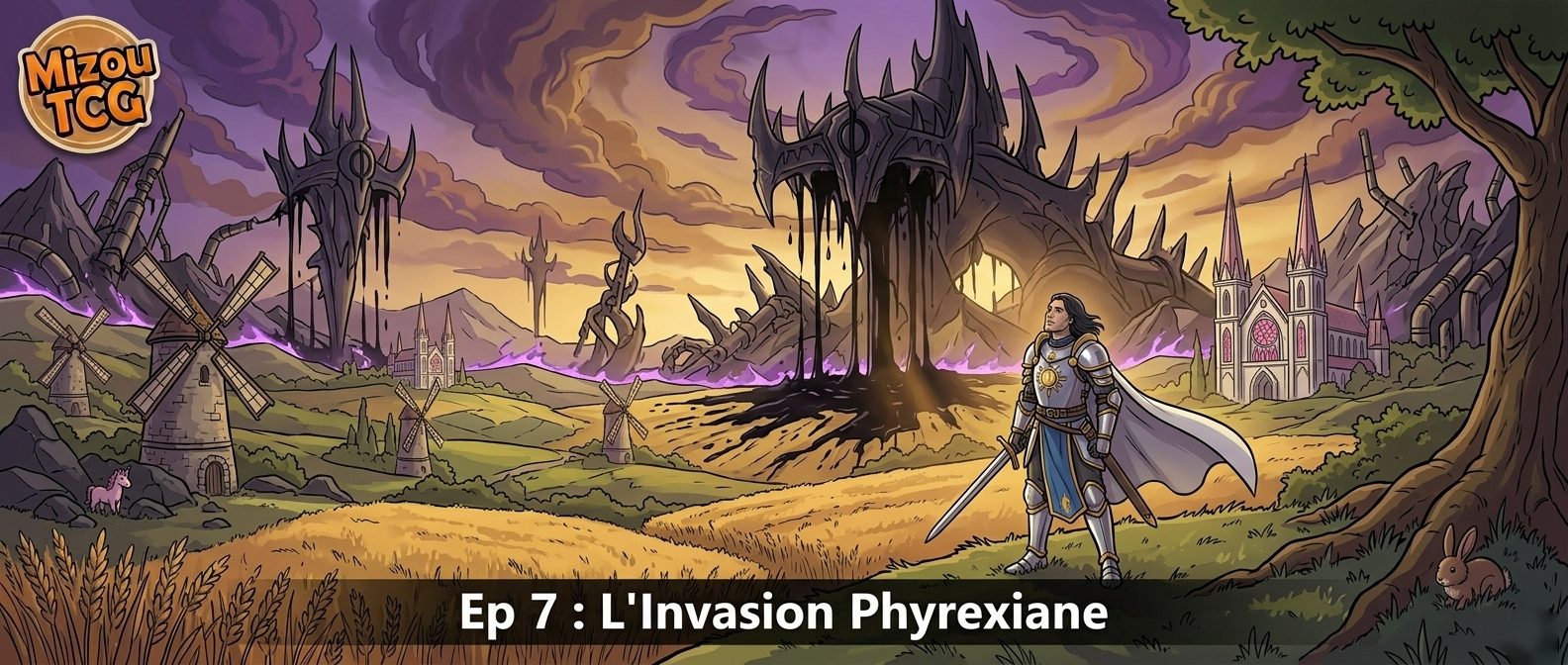
The sky over Benalia suddenly darkened. Not clouds, but something far more sinister: entire sections of another world were materializing in the atmosphere. Black fortresses, grotesque war machines, armies of creatures half flesh, half metal. After millennia of preparation in the nine spheres of their artificial hell, the Phyrexians had come to claim Dominaria.
Welcome to episode 4 of our exploration of Magic: The Gathering lore. After following the saga of Urza and the adventures of the Weatherlight's crew, we reach the culminating moment of the Ancient Era: the Phyrexian Invasion, one of the most devastating wars the Multiverse has ever known.
The Overlay: When Two Worlds Merge
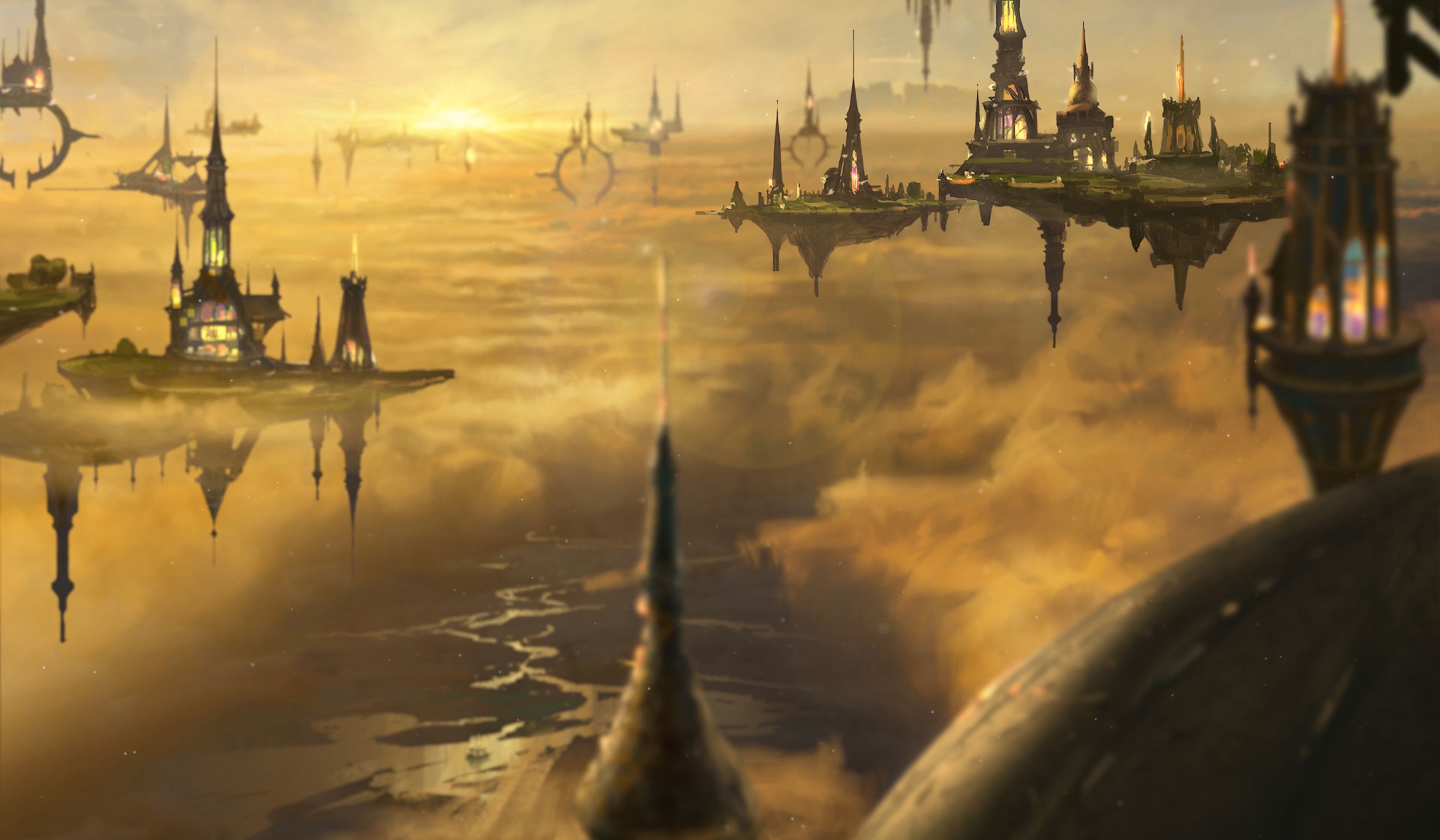
To grasp the scale of the invasion, one must first understand its mechanism. Yawgmoth did not simply open portals to send his troops through — he did something far more radical and terrifying: he merged two planes of existence.
Rath, that artificial plane created by Phyrexia as a beachhead, had been accumulating matter for centuries. Entire continents, forests, creatures — everything had been prepared for this singular moment. During the Overlay (the "superposition"), Rath literally fused with Dominaria, instantly pouring millions of Phyrexians onto the birthplace of magic.
Imagine for a moment: you are standing in a peaceful field, and suddenly a monstrous fortress materializes before you, its walls oozing black oil, its gates vomiting hordes of mechanical monstrosities. This is what Dominaria's inhabitants experienced that day, simultaneously, across the entire plane.
The Overlay process was not only physical — it was also magical. Dominaria's ley lines were disrupted, certain mana sources corrupted by Phyrexian oil. Sacred sites were desecrated within seconds. The land itself seemed to scream under this cosmic violation.
The Perfect Coordination
The invasion was not chaotic — it was surgically precise. The portals opened simultaneously across all of Dominaria's major continents:
- Benalia: The chivalric nation, symbol of order and light
- Llanowar: The ancestral forests of the elves
- Urborg: The cursed swamps, already close to darkness
- Shiv: The volcanic mountains of the dragons and viashino
- Keld: The lands of the barbarian warriors
- Yavimaya: The sentient forest and its protectors
Every invasion point had been chosen with care to maximize chaos and prevent any coordinated defense. Yawgmoth had studied Dominaria for millennia — he knew every weakness, every rivalry between nations he could exploit. Magical communications were jammed within the first hours, isolating each region in its own nightmare.
The Fall of Benalia
The first great tragedy of the invasion was the fall of Benalia. This nation embodied everything Phyrexia despised: honor, faith, resistance to corruption. The Benalish knights were renowned throughout Dominaria for their bravery and devotion to justice.
On the left, the Benalish Hero represents the martial tradition of this nation — fighters ready to give their lives for their ideals. In the center, the Benalish Knight embodies the elite of their army, those armored cavalry who held for hours against overwhelming forces. On the right, the Benalish Commander shows the leadership that tried, in vain, to coordinate an impossible defense.
But even the purest courage is powerless against infinite waves of mechanical horrors. The Phyrexians knew neither fatigue, nor fear, nor mercy. For every machine destroyed, ten more took its place. The walls of Benalia, which had withstood centuries of wars, crumbled within days.
The accounts of survivors speak of apocalyptic scenes: centuries-old cathedrals reduced to ashes, libraries holding centuries of knowledge consumed by flames, families separated in the panic of evacuations. Proud Benalia, symbol of civilization, had become a charnel house.
General Tsabo Tavoc
Leading the assault on Benalia, a terrifying figure emerged: Tsabo Tavoc, the Phyrexian general. Unlike many of Phyrexia's creatures, Tsabo possessed formidable tactical intelligence and calculated cruelty.
Tsabo Tavoc was a nightmarish creature: a giant spider's body fused with mechanical implants, topped by a humanoid torso with multiple blade-arms. She did not merely kill — she collected. The bodies of her most notable victims were displayed as trophies, a psychological technique aimed at breaking the defenders' morale.
Her most feared ability was to specifically target legends — the heroes, commanders, those who inspired resistance. Under her command, the Phyrexian forces did not strike at random: they methodically decapitated enemy leadership. Benalish captains quickly learned that displaying their rank was equivalent to painting a target on their backs.
It is said that Tsabo kept a detailed register of every legend killed, classifying her victims by importance and method of execution. For her, war was not merely conquest — it was a macabre art.
The Weatherlight in the Maelstrom
While Benalia fell, the Weatherlight's crew found itself at the heart of the action. Gerrard Capashen, the chosen one of the Legacy, was no longer the reluctant hero of the early days — the invasion had transformed him into a war commander.
The flying ship, with its unique ability to travel between planes, became a major strategic asset for the Coalition. Able to appear anywhere in an instant, the Weatherlight served by turns as an emergency transport, a rapid-strike vessel, and a symbol of hope for demoralized troops.
But the crew paid a terrible price. Hanna, the brilliant navigator and Gerrard's love, contracted the Phyrexian plague during a rescue mission. Despite the efforts of Orim, the ship's healer, the disease progressed inexorably. Gerrard had to watch the woman he loved wither day after day, powerless against a corruption that no magic could stop.
Hanna's death broke something in Gerrard. The man who had still hesitated a few weeks earlier to assume his destiny became an implacable force of destruction against Phyrexia. His rage, channeled through his sword, made him one of the Coalition's most feared fighters.
The Formation of the Coalition
In the face of this existential threat, something extraordinary occurred: nations that had fought each other for centuries decided to unite. This unlikely alliance took the name Coalition.
The architect of this union was none other than Urza. The planeswalker who had spent four millennia preparing for this moment summoned Dominaria's leaders to the ruins of Koilos — the very site where he and his brother Mishra had discovered the power stones that triggered the Brothers' War.
Urza's speech at Koilos has remained in memory. For the first time, this cold and calculating strategist spoke with passion. Before an assembly of kings, generals, druids and mages — many of them his former enemies — he spoke words that would change the course of history:
"I have seen a thousand worlds burn. I have seen entire civilizations reduced to ashes by the Phyrexian machine. I have seen entire peoples transformed into slaves of metal and corrupted flesh. Dominaria will not fall. Not as long as a single one of us remains to stand against the darkness. Our differences, our quarrels, our old grudges — none of it matters anymore. Today, we are all Dominarians. Today, we fight together, or we die apart."
The United Nations
The Coalition brought together diverse forces, each contributing unique strengths:
On the left, Eladamri, Lord of Leaves, leader of the elves of Rath who had taken refuge on Dominaria. Himself a victim of Phyrexian oppression for years on Rath, he had sworn never to flee again. His experience fighting the Phyrexians made him an invaluable tactical advisor. In the center, Lin Sivvi, Defiant Hero, commander of the human resistance, a brilliant tactician who excelled at guerrilla warfare and sabotage operations. On the right, Tahngarth, the minotaur first mate of the Weatherlight, whose pride shattered by Volrath had transformed into vengeful rage against everything bearing Phyrexia's mark.
But unity was not simple. Llanowar's elves despised the humans who had deforested their woodland for generations. Keld's warriors considered any alliance a weakness unworthy of true fighters. Tolaria's mages distrusted non-magical soldiers they deemed primitive. And Urborg's necromancers were viewed with suspicion by all the others.
Urza had to deploy all his diplomacy — and sometimes his threats — to hold this fragile coalition together. More than once, disputes broke out at war councils. More than once, generals threatened to withdraw their troops. But each time, the horror of the alternative — Phyrexia's victory — brought the reluctant parties back to the table.
The Battles of Dominaria
The invasion unfolded on many simultaneous fronts. Each battle was a potential disaster; each defeat risked bringing the entire Coalition crashing down.
The Defense of Llanowar
The forests of Llanowar, sanctuary of the elves for millennia, were among the first targets. The Phyrexians did not come merely to conquer — they came to transform. Their objective was to convert the age-old trees into biomass for their war machines.
The elves of Llanowar fought with desperate ferocity. Their intimate knowledge of the forest allowed them to set ambushes, harass Phyrexian supply lines, and turn every grove into a deadly trap. On the left, the Llanowar Elves, those druids connected to the earth who channeled the forest's mana to fuel the resistance. In the center, the Llanowar Sentinel, symbol of the elves' eternal vigilance. On the right, the Elvish Champion, rallying his kin for suicidal charges against the machines.
The very trees seemed to fight. The druids awakened the sylvan spirits, the treants who had slept for centuries. Those giants of wood and moss crushed entire columns of Phyrexians before falling to enemy fire.
Despite their efforts, the forest burned. Trees ten thousand years old fell beneath mechanical axes. But each tree felled cost the Phyrexians hundreds of their creatures. The forest of Llanowar was not conquered — it was contested inch by inch, tree by tree.
The Siege of Urborg
Urborg presented a particular case. This cursed swamp, land of necromancers and undead, seemed almost naturally aligned with Phyrexia. Many thought Urborg would fall without a fight, or worse, that it would join the invader.
They were gravely mistaken.
The lich lords of Urborg had their own vision of undeath — a vision incompatible with the Phyrexian notion of "perfection." Where Phyrexia sought to fuse flesh and metal in a nightmarish uniformity, Urborg practiced a more ancient, more subtle necromancy that preserved the identity of its servants. An ideological war as much as a military one broke out in the swamps.
Urborg's undead proved excellent fighters against Phyrexia. They felt no fear of death, no pain, and could be reanimated again and again as long as their necromancers survived. Urborg's wizards recycled Phyrexian bodies themselves, turning the machines against their creators in a particularly bitter irony.
This irony was not lost on Yawgmoth. Seeing his own creations, which he considered the apex of evolution, used against him like common zombies, filled him with cold rage. He ordered the total annihilation of Urborg — not its conversion, but its pure and simple destruction. If these lands could not be Phyrexianized, they would be reduced to ashes.
The Battle of Shiv
The volcanic mountains of Shiv harbored two distinct populations: the viashino (warrior lizard-folk) and the dragons. These two groups had traditionally ignored one another, or even clashed, but the invasion forced them to cooperate.
Shiv witnessed the return of the Primeval Dragons, ancient creatures that had slept for centuries in the volcanic depths. Awakened by the magical disruption of the invasion, they emerged to defend their homeland. On the left, Rith the Awakener, whose breath could make life bloom even on devastated battlefields. In the center, Treva the Renewer, able to restore allied forces by her mere presence. On the right, Darigaaz the Igniter, the fiercest of the dragons, whose flames could melt even the most resilient Phyrexian steel.
These dragons were not mere beasts — they were conscious beings, millennial strategists who had watched civilizations rise and fall. Under their command, the viashino and Coalition forces coordinated a devastating aerial defense. The skies of Shiv became hell for Phyrexian ships. Shiv's forges, which had once produced legendary weapons, were repurposed to manufacture weapons specifically designed against Phyrexian metal.
The Sacrifice of Barrin
Of all the invasion's tragedies, none equals that of Barrin. The Archmage of Tolaria, Urza's friend and confidant for centuries, had sacrificed everything for the war against Phyrexia. His life, his time, his energy — all had been devoted to this cause.
But Barrin had not only sacrificed his time. He had also sacrificed his family.
His wife, Rayne, had been killed by a Phyrexian spy who had infiltrated Tolaria years earlier. A sleeper agent whom nobody had suspected, not even the brilliant Barrin. This death had haunted him for years, feeding a guilt that never left him.
And now, his daughter, Hanna — the Weatherlight's navigator, Gerrard's love — succumbed to the Phyrexian plague during the invasion. The disease had consumed her slowly, inexorably, before her father's helpless eyes. Two losses that would have broken any man.
The Obliteration
When Barrin learned of Hanna's death, something broke in him definitively. The man who had spent his life teaching restraint, precision, magical control — that man decided to let everything go.
Tolaria was under siege. Thousands of Phyrexians were converging on the academy, seeking to seize the temporal secrets it held. Urza's experiments on time, the knowledge accumulated over centuries — if these secrets fell into enemy hands, Phyrexia could manipulate time itself.
Barrin knew everything would be lost. He made a decision.
Barrin channeled all his power, all his despair, all his rage into a single spell. Not a fireball. Not a lightning bolt. An Obliteration — the total annihilation of everything that existed in the area. The island of Tolaria, the academy, the Phyrexians, the secrets... and Barrin himself.
When the light faded, nothing remained. No ruins. No bodies. Not even ashes. Just a smoking crater in the ocean where the greatest magical institution in Dominaria had stood. Thousands of Phyrexians had been annihilated in an instant.
Urza, observing from a distance through his planeswalker senses, remained silent for a long moment. Then he murmured:
"Farewell, my old friend. You did what I was never able to do: choose love over victory."

The Nine Titans
Despite the sacrifices, despite battles won, the Coalition was only delaying the inevitable. The Phyrexians were too numerous, too resilient. As long as Phyrexia itself existed, new waves would crash in endlessly.
Urza knew this from the beginning. The invasion of Dominaria was only part of his plan. The real battle had to be fought elsewhere — in the very heart of Phyrexia.
The Titan Engines
For centuries, Urza had secretly been building ultimate weapons: the Titan Engines, giant combat suits powered by power stones. These machines, several meters tall, were designed for a single purpose: to transport planeswalkers to the heart of Phyrexia and allow them to survive long enough to destroy it.
But a single Titan Engine was not enough. Urza needed pilots — planeswalkers powerful enough and mad enough to accompany him on this suicide mission. He gathered the Nine Titans:
- Urza — The leader, the mission's architect, the one who had planned everything
- Bo Levar — A smuggler turned planeswalker, pragmatic and cunning
- Commodore Guff — An eccentric who read destiny in books from other realities
- Daria — A warrior from Shiv, fierce and loyal
- Freyalise — The elven planeswalker who had ended the Ice Age on Dominaria
- Kristina of the Woods — A powerful druidess, connected to the forces of nature
- Lord Windgrace — A panther-man protecting Urborg, noble and wise
- Taysir — The most powerful of all, born from the fusion of five versions of himself from different worlds
- Tevesh Szat — The traitor
The Foreseen Betrayal
Urza knew that Tevesh Szat was a traitor. This dark planeswalker had a long history of manipulation, murder and betrayal. So why include him in the most important mission of all time?
Because Urza needed his power. And because Urza had calculated everything.
Urza's plan was coldly calculated: let Tevesh Szat reveal his true nature during the mission, then eliminate him and absorb his planeswalker spark. This extra energy — the very essence of an ancient planeswalker — would be needed to fuel the mission's final phase.
When Tevesh Szat did indeed stab his companions in the back, killing Daria and Kristina in their sleep, Urza was ready. He confronted the traitor and, in a brutal duel at the very heart of Phyrexia, absorbed his essence. Two planeswalkers — allies — were dead, but the mission now had the resources needed to continue.
This cold logic perfectly encapsulates Urza. For him, everything was a calculation. Even the lives of his allies were merely variables in the equation of victory. This revelation profoundly shocked the other Titans, who understood that they were nothing but pawns on Urza's chessboard.
The Invasion of Phyrexia
The surviving Titans penetrated the nine spheres of Phyrexia. What they discovered there surpassed their worst nightmares.
The Nine Spheres
Phyrexia was not a world — it was a machine on the scale of a plane. Nine concentric spheres, each dedicated to a specific function in Yawgmoth's great work:
- The Surface — Desolate wastes, war forges, where armies were assembled
- The Oil Sea — Oceans of corrupting black liquid, the blood of Phyrexia
- The Domains of the Priests — Phyrexian religious hierarchy, temples dedicated to the Father of Machines
- The Fourth Sphere — Body "recycling" camps, where matter was transformed
- The Fifth Sphere — Transformation laboratories, where creatures were "improved"
- The Sixth Sphere — Arsenals and armories, storing weapons beyond number
- The Seventh Sphere — The Vat, nurseries of new Phyrexians, where artificial life was created
- The Eighth Sphere — Domain of the elite, where generals and high priests resided
- The Core — Dwelling of Yawgmoth himself, the beating heart of the entire plane
The Titans had to cross each sphere, facing ever-greater horrors, to reach the Core and destroy Yawgmoth at his source.

These three cards illustrate the essence of Phyrexia. On the left, the Phyrexian Arena — a place where power is bought at the price of blood, where every advantage demands a sacrifice. In the center, the Phyrexian Altar — Phyrexia's religion incarnate, where sacrifices fuel the divine machine. On the right, the Phyrexian Processor — the machines that transform life into unlife, flesh into metal, the individual into a component.
The Partial Failure
The Titans' mission was a partial failure. They inflicted considerable damage on the upper spheres, destroying crucial forges and freeing prisoners. But they were unable to reach the Core.
Yawgmoth was too powerful. After millennia of fusion with his artificial plane, the Father of Machines was no longer truly a creature — he had become Phyrexia itself. His thoughts coursed through every cable, his essence permeated every drop of oil. To kill him, one would have to destroy the entire plane.
And that was impossible... unless Yawgmoth left Phyrexia to come to Dominaria in person.
Which was exactly his intention from the start.
Preparing for the Apocalypse
Yawgmoth had foreseen this final confrontation from the beginning. The invasion was only a prelude — a way to weaken Dominaria, kill its defenders, corrupt its mana sources, before his personal arrival.
The Father of Machines began to prepare his crossing. An operation of unimaginable complexity, since he could not simply "walk" to Dominaria like a planeswalker. No, Yawgmoth had to manifest in another way: as a force of pure death, a cloud of destruction capable of consuming everything it touched.
While the Titans retreated from Phyrexia, wounded and diminished, Yawgmoth gathered his power. On Dominaria, the Coalition sensed the end approaching. The elven oracles prophesied a "great darkness." The necromancers of Urborg perceived a disturbance in the very flow of death. The dragons of Shiv growled, sensing a threat they could not name.
Urza knew exactly what was about to happen. And for the first time in his long four-thousand-year existence, he was not certain that his plan would suffice.
Summary: The Prelude to the Apocalypse
The Phyrexian invasion had changed Dominaria forever. Entire nations had been devastated. Millions of lives had been lost. Legendary heroes had made the ultimate sacrifice.
On the left, Coalition Victory represents hope — proof that even in the face of the impossible, union can triumph. In the center, Barrin's Obliteration reminds us of the cost of this war — the personal sacrifices that will never be forgotten. On the right, Urza's Rage embodies the planeswalker's implacable determination — a rage that had burned for four thousand years and was about to reach its apex.
Here is what the Invasion established:
- The Coalition — The first true alliance of all Dominaria's peoples, a unity forged in the fire of war, proving that ancestral divisions could be overcome
- The sacrifice — Barrin, Daria, Kristina, Hanna, and so many others gave their lives so that others might survive
- The final threat — Yawgmoth himself is preparing to manifest on Dominaria, a terrifying prospect that even the most optimistic dare not contemplate
- The Legacy — All the pieces assembled by Urza over millennia are now in the hands of Gerrard and the Weatherlight
- Urza's choice — The planeswalker must now decide how far he is willing to go to win — and that choice will define the fate of the entire Multiverse
In the next episode...
Episode 5: The Apocalypse
Yawgmoth crosses to Dominaria as a death cloud, consuming everything he touches. Urza faces an unexpected temptation — to join his enemy rather than fight him. Gerrard must make an impossible choice that will determine the fate of Dominaria. And Urza's Legacy finally fulfills its destiny in a sacrifice that will end four thousand years of conflict. The conclusion of the Urza Saga, the most epic moment in Magic: The Gathering history.
Sources
- Invasion (J. Robert King, 2000) — Main invasion novel, covering the Overlay and the first battles
- Planeshift (J. Robert King, 2001) — Direct sequel, detailing the Nine Titans' mission
- Invasion expansion (2000) — First expansion of the block, introducing coalition mechanics
- Planeshift expansion (2001) — Second expansion, exploring Phyrexia and its horrors
- MTG Wiki — Articles on the Phyrexian Invasion, Barrin, the Nine Titans
Products related to this episode
Relive this saga with cards from the corresponding expansions:
Products - La Guerre Fratricide